Share this
by MoeGo on Mar 9, 2026 9:00:00 AM
If your dream job has always been to play with dogs all day, starting a dog boarding business might sound like a no-brainer. Still, being a business owner is hard — especially when you run a business that never truly closes like a pet boarding business. Luckily, we’ve got you covered with this step-by-step guide that will have you on your way to opening a dog boarding business in record time.

Quick Answer: How do you start a dog boarding business?
To start a dog boarding business, you typically:
- confirm zoning + licensing requirements, 2) validate local demand and pricing, 3) build a budget and cash runway, 4) secure a safe facility and insurance, 5) set strict intake policies (vaccines, behavior, emergency care), 6) hire and train staff, and 7) run bookings, payments, and client communication through a single operating system to prevent no-shows and admin overload.
Why Start a Dog Boarding Business?
Dog boarding demand is driven by a simple reality: people travel, work unpredictable schedules, and treat pets like family. A well-run boarding facility provides something owners will pay for: trust + safety + consistency.
But boarding is also one of the most operationally intense pet businesses:
- It never truly “closes”
- Labor and sanitation are constant
- Safety and liability expectations are high
- One incident can damage your reputation
If you like animals and you’re willing to build repeatable systems, boarding can be a durable business.
Step 1: Validate the Idea (Regulations + Market Demand)
Before you sign a lease or build kennels, do two things in parallel:
1. Confirm legal and zoning requirements
Call your:
- City/county clerk or business licensing office
- Zoning department
- Local animal control (often has kennel rules)
Ask directly:
- Is boarding permitted at this address?
- What permits/inspections are required?
- Are there limits on dog count, noise, outdoor runs, signage, parking?
Even home-based boarding can be restricted.
2. Confirm demand (and whether it’s profitable demand)
Demand isn’t just “people need boarding.” It’s:
- Are good facilities fully booked during holidays?
- Are owners complaining about waitlists?
- Do nearby vets/apartments get frequent boarding requests?
3. Map your competitors (this is where your positioning comes from)
Look at:
- Rates (weekday vs weekend, holiday pricing)
- Review patterns (complaints often reveal your wedge)
- Services offered (medication administration, playtime add-ons, suites vs standard)
Bounce-lowering tip: Add a short “Local Research Checklist” callout box here so readers can screenshot it.
Step 2: Define Your Business Model (Before You Build Anything)
Most boarding businesses fail from unclear scope. Decide early:
- Facility boarding vs home-based boarding
- Dogs accepted (size, temperament, intact vs fixed policies)
- Boarding only vs boarding + daycare
- Add-ons: grooming, training, retail, pick-up/drop-off
- Overnight staffing model (who is onsite, when, and why)
Operator reality: The more services you add, the more scheduling, staffing, and communication complexity you inherit. Plan systems accordingly.
Step 3: Build a Budget That Can Survive Reality
1: Estimate your revenue (based on safe capacity)
Start with:
- Safe overnight capacity (not “how many could fit”)
- Average nightly rate
- Expected occupancy (be conservative early)
Example math (replace with your numbers):
Capacity 20 dogs × $55/night × 60% occupancy × 30 days ≈ monthly boarding revenue
2: Subtract fixed expenses
Typical monthly fixed expenses:
- Rent / mortgage
- Payroll (largest)
- Utilities
- Insurance
- Waste disposal / laundry
- Software + payment processing
- Cleaning supplies
- Marketing
If fixed expenses are close to projected revenue, you don’t have a boarding business—you have a stress machine. Adjust:
- rates
- capacity strategy
- staffing structure
- facility choice
3: Plan for cash runway + contingencies
Boarding has seasonality. Holidays spike, shoulder seasons dip. Build for:
- emergency vet situations
- equipment failure
- sudden staffing gaps
Step 4: Secure the Right Location (and Don’t Overbuy Space)
Location matters, but not for the reason people think. It’s less “visibility” and more:
- safe drop-off / pick-up flow
- noise tolerance
- compliance feasibility
- staff commute practicality
- buildout costs
Operator advice: Your first location doesn’t need to be your forever location. Many strong operators start smaller, get consistent occupancy, then expand once systems are proven.

Step 5: Get Insurance Right (Non-Negotiable)
Most boarding businesses start with:
- General liability insurance
- Animal bailee (care, custody, and control)
- Commercial property insurance
You may also need:
- workers’ comp (if you have employees)
- commercial auto (if transporting pets)
- employee bonding (risk management)
Also build written incident protocols for:
- bites
- escapes
- injury
- emergency veterinary care authorization
This protects the dog, the client, and your business.
Step 6: Design and Equip Your Facility for Safety + Throughput
Boarding is a sanitation and flow business. Equipment should support:
- separation by household and temperament
- quick cleaning between guests
- medication storage and tracking
- safe indoor/outdoor transitions
Boarding essentials checklist
- secure kennel runs or rooms (separation is mandatory)
- washable bedding
- food/water bowls
- locked med cabinet
- spare leashes/collars/harnesses
- first aid kits (human + canine)
- cleaning supplies rated for pet facilities
- enrichment toys (sanitizable)
Optional (high-value) upgrades
- ventilation improvements
- sound dampening
- camera system (risk + trust)
- enrichment-feeding tools
- staff communication station (visible notes, shift handoffs)
Step 7: Hire and Train a Team You Can Trust
You can’t run boarding safely if staffing is improvised.
Hire for:
- calm temperament and situational awareness
- reliability (boarding requires coverage)
- ability to follow protocols
- comfort with cleaning and routine work
Train on:
- dog body language
- safe separation and handling
- sanitation standards
- emergency procedures
- client communication standards
Turnover is expensive. The most scalable boarding businesses build repeatable training and workflows early.
Step 8: Set Policies That Prevent Chaos (and Protect Margin)
Policies reduce conflict, reduce risk, and protect profitability.
Minimum intake policies:
- vaccination requirements
- parasite prevention expectations (if applicable)
- behavior assessment / trial day
- medication disclosure
- emergency vet authorization
- cancellation / no-show / late pickup fees
Important: New owners often say yes to everyone. Strong operators protect the pack (and the staff) by saying no when needed.
Step 9: Attract Clients Without Discounting Yourself to Death
What actually drives boarding bookings
- Google reviews and local reputation
- clear policies that signal professionalism
- easy booking + fast responses
- proof of safety (cleanliness, protocols, optional cameras)
- consistent communication
Low-bounce marketing assets to add
- “Boarding Checklist for New Clients” (downloadable)
- Pricing + what’s included (simple, transparent)
- FAQ section (wins AEO + reduces repetitive inquiries)
- Photo tour of facility
- Clear online booking CTA
Step 10: Run Smooth Operations (So You Don’t Burn Out)
Once you’re booked, the problem becomes operations:
vaccination chasing, schedule changes, payment follow-up, staff handoffs, and client comms.
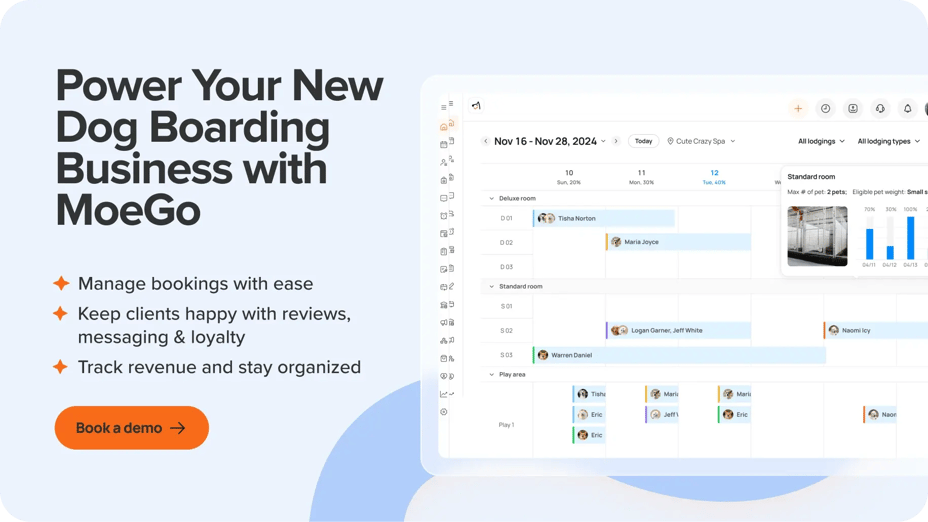
This is where a single operating system matters most:
- booking rules and capacity control
- automated reminders
- centralized pet profiles and vaccination status
- incident notes visible to the whole team
- integrated payments (less chasing)
Owners don’t burn out from dogs. They burn out from admin + preventable chaos.

Frequently Asked Questions
Do I need a license to start a dog boarding business?
Usually yes. Requirements vary by city and state and may include business licensing, kennel permits, zoning approval, and inspections.
How much does it cost to start a dog boarding business?
Costs range widely depending on home-based vs commercial facility, buildout requirements, and staffing. Common drivers include leasing/buildout, insurance, and payroll.
Is a dog boarding business profitable?
It can be, but profitability depends on occupancy, labor management, pricing discipline, and preventing revenue leakage from cancellations and no-shows.
What insurance do I need for dog boarding?
Most facilities need general liability plus animal bailee (care, custody, and control). Many also carry commercial property insurance; employers may need workers’ comp.

Just starting or adding to your business?
We have flexible plans meant for all stages.


Can You Run a Dog Grooming Business From Home in 2026?
How to Start a Successful Dog Boarding Business in 2026

How to Start a Dog Daycare in 2026: A Step-by-Step Business Guide