Share this
by MoeGo on Jun 29, 2026, 6:05:25 PM
You did everything right.
You showed up on time. You gave an amazing groom, a stress-free boarding stay, or a genuinely fun daycare day. The pet went home happy. The owner was thrilled.
And then they went to refer you to a friend, and the friend visited your website, couldn’t figure out how to book, and booked someone else instead.
That’s the invisible leak. It’s not a service problem. It’s a website problem. And it’s costing pet businesses real revenue every single day.
Today, we’re going to fix it, all with a simple five-question framework you can use to audit your own homepage in the next 15 minutes.
Why Your Homepage Is a Booking Decision, Not a Welcome Mat
Most pet business websites were built to look professional. But modern pet parents aren’t visiting your website to admire it. They’re visiting with a specific question in mind: “Can I trust this place with my pet, and can I book quickly?”
If your homepage doesn’t answer that question in the first few seconds, they leave. Not because your service is bad. Because the experience of your website didn’t match the convenience they expect everywhere else in their life.
Think about how pet parents book everything else: groceries via Instacart in two taps, travel on Airbnb in under a minute, rides on Uber in seconds. Your competitor down the street. or across the country, is only a Google search away.
Convenience is no longer a nice-to-have. It’s part of trust.
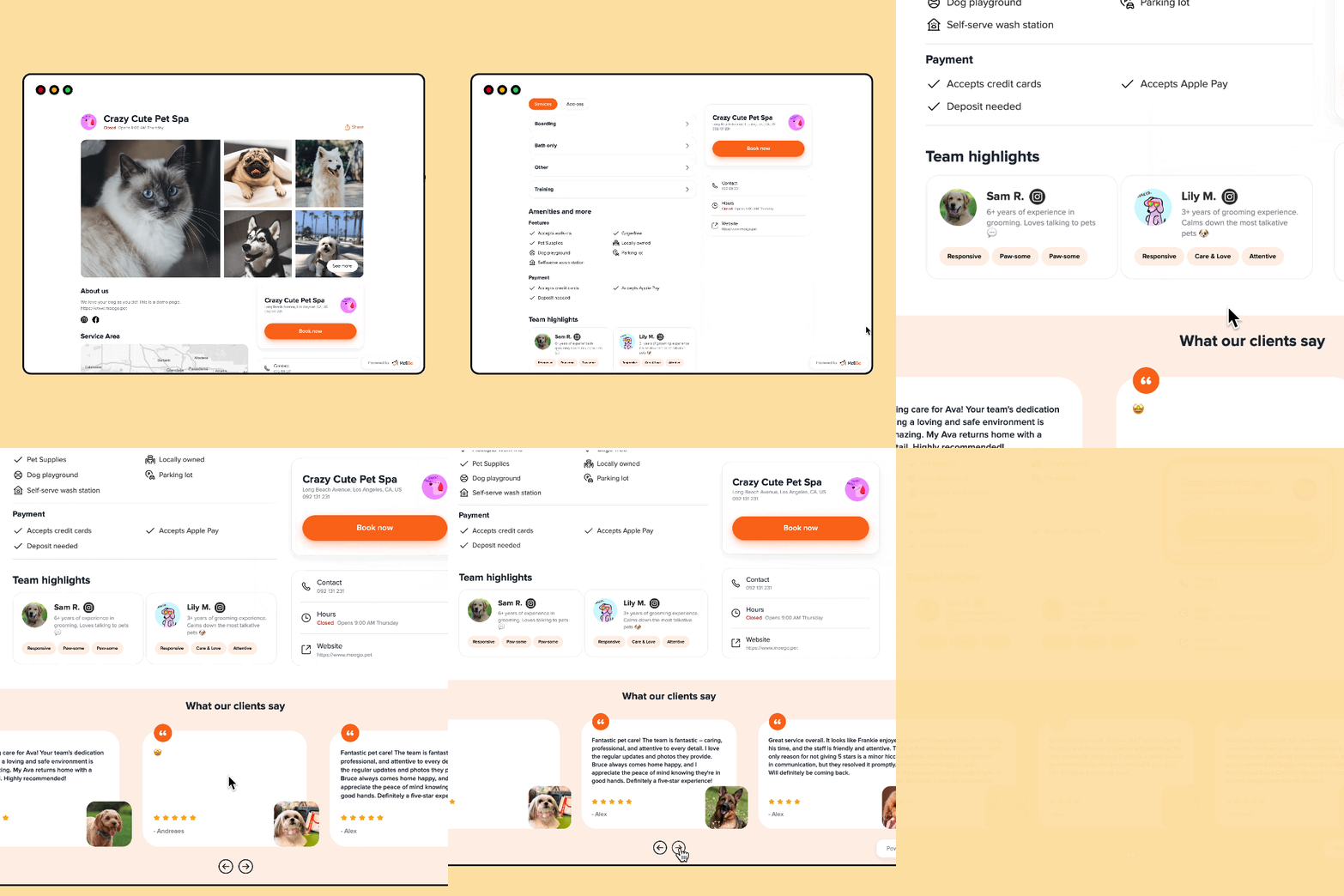
The 5-Question Homepage Audit
Walk through each of these questions as if you’re a first-time visitor to your own site. Better yet, ask someone who’s never seen your website to answer them cold.
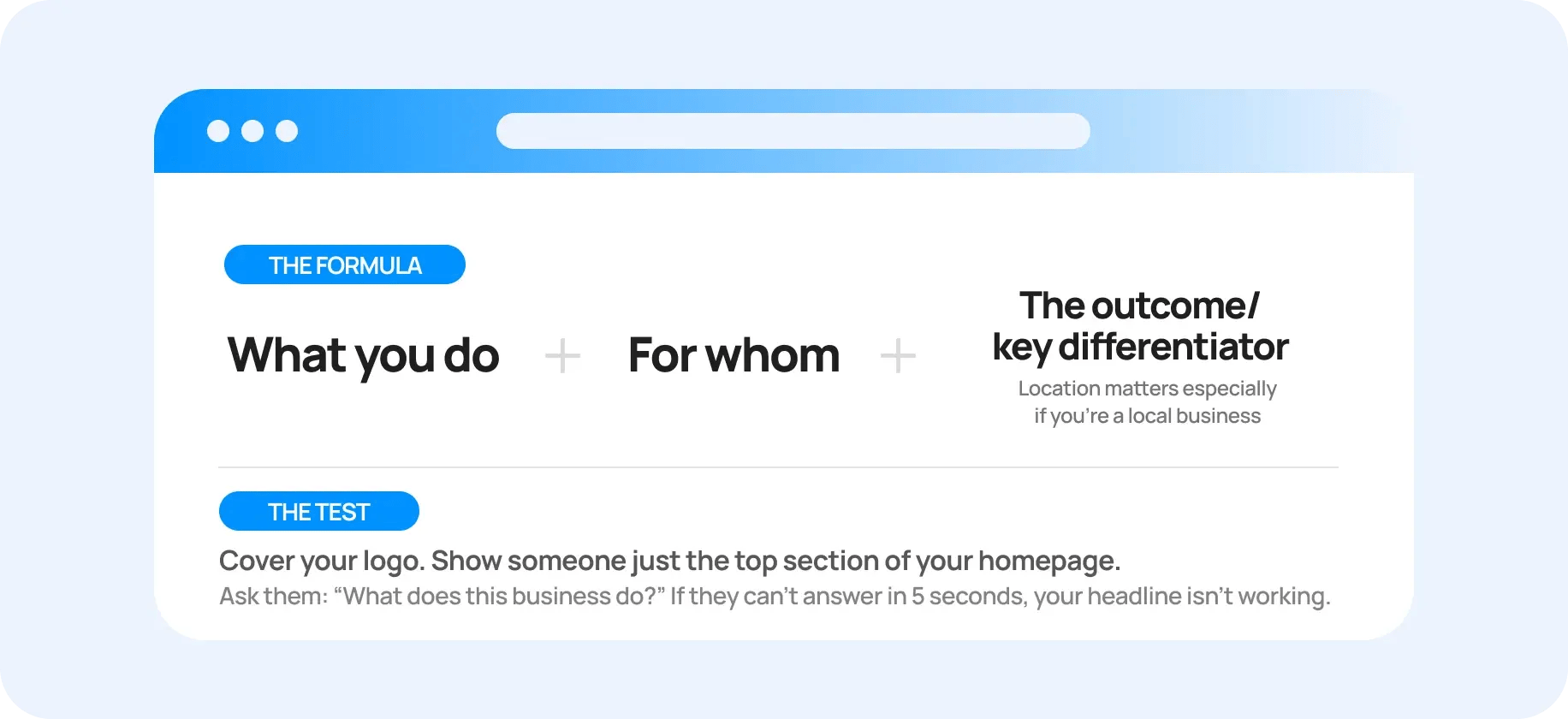
Question 1: Within 3 seconds, do I know what you do and who you do it for?
The top of your homepage (the “above the fold” section that’s visible without scrolling) needs to do one job: tell a stranger exactly what you offer and for whom.
Weak answer: “Welcome to Pawsome Pals!”
This tells a visitor nothing. It doesn’t say what you do, where you are, or who you serve.
Strong answer: “Stress-free grooming for Austin dogs — walk-in and appointment slots available.”
This lands in under five words what matters: the service, the city, and a hint of what makes you different (stress-free).
Question 2: Can I trust you with my pet?
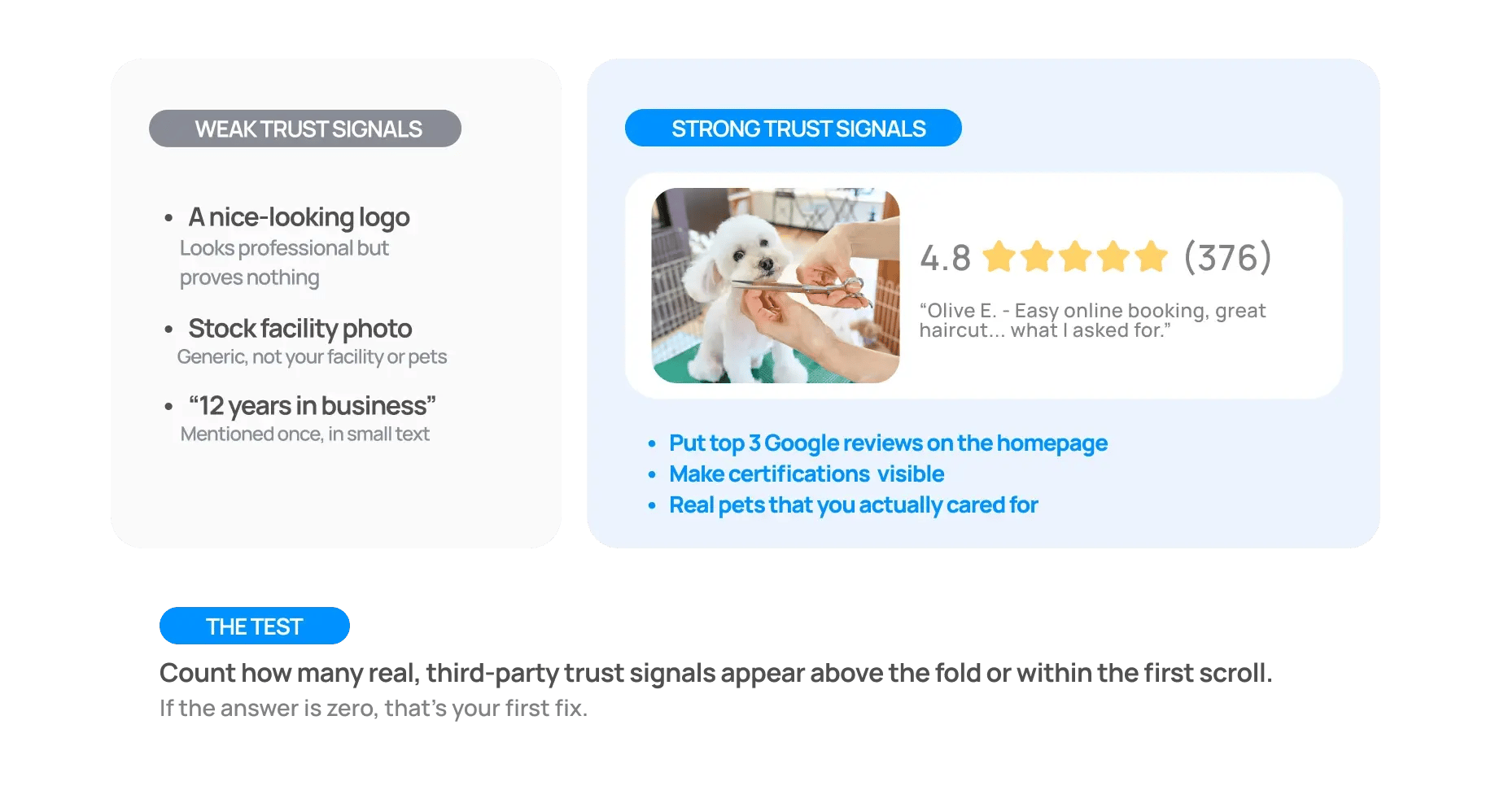
Pet parents aren’t just buying a service — they’re handing over a family member. Trust signals on your homepage answer the unspoken question: “Are you actually good at this?”
Weak trust signals:
- A professional-looking logo
- A photo of a clean facility
- Your years in business (mentioned once, in small text)
Strong trust signals:
- Real Google reviews displayed prominently (with star ratings and reviewer names)
- Photos of actual pets you’ve cared for (not stock photography)
- Specific credentials, certifications, or training (e.g., “Fear Free Certified”)
- A clear “About Us” that sounds like a human wrote it — because it did
Question 3: What do you actually offer and what does it cost?
Pet parents comparison-shop. If they can’t find your services and approximate pricing on your homepage or one click away, many of them will simply find someone whose website does make that easy.
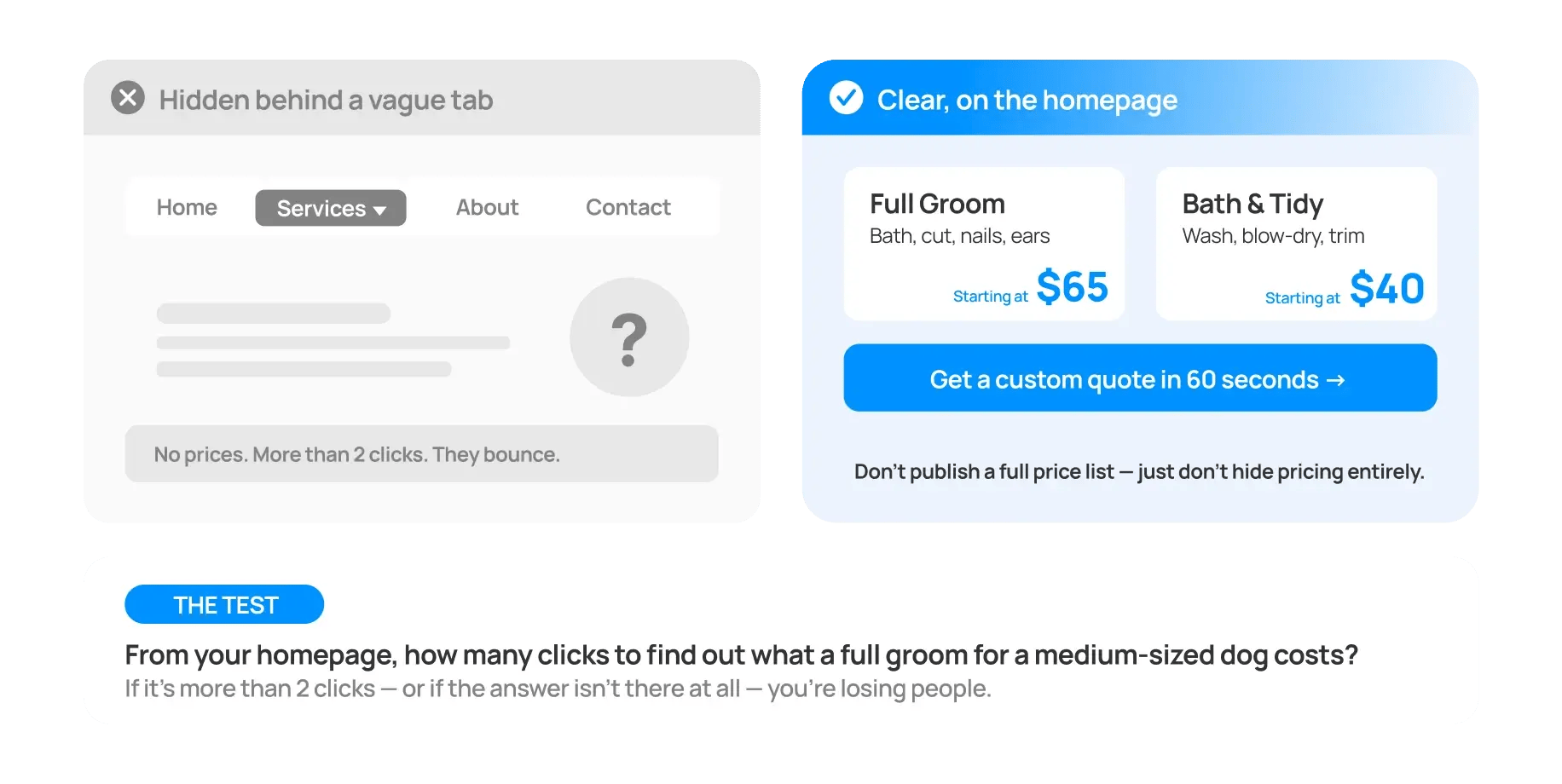
Weak: A “Services” tab that leads to a page with vague descriptions and no prices.
Strong: A clean services section on the homepage (or prominently linked) that outlines: what’s included, who it’s for, and either pricing or a “starting at” range.
You don’t have to publish your full price list. But hiding pricing entirely creates friction. Friction kills bookings.
Question 4: How do I book and how easy is it?
This is the most important question on your entire website, and it’s the one most pet businesses make hardest to answer.
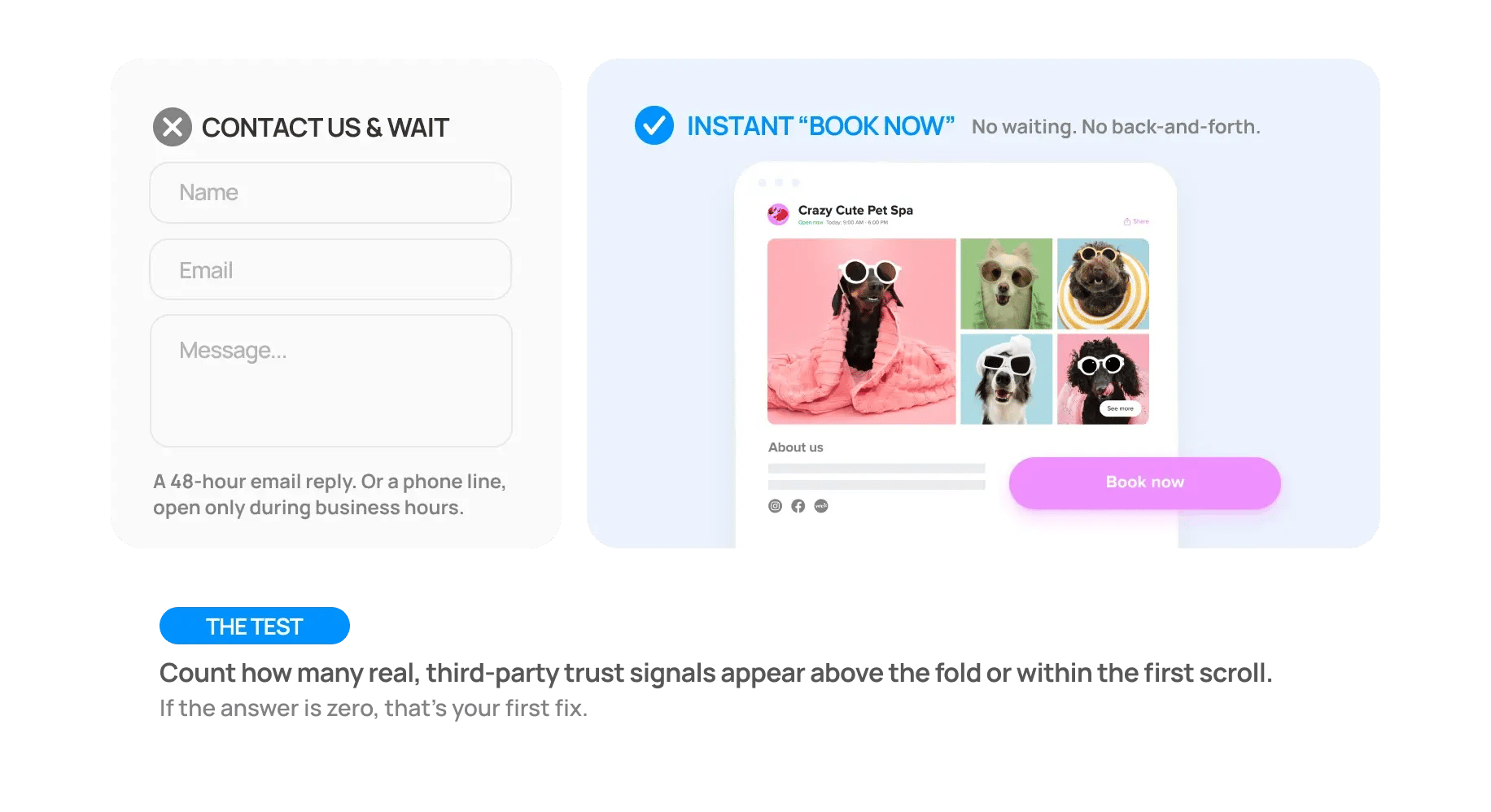
Weak: A “Contact Us” form that leads to a 48-hour email wait. Or a phone number during business hours only.
Strong: A prominent “Book Now” button in the top navigation and above the fold that opens an online booking flow immediately. No waiting. No back-and-forth.
The Millennial and Gen Z pet parents, who are your most valuable and fastest-growing customer segment, grew up booking everything online. They don’t want to call. They don’t want to wait. They want to book at 10pm on a Sunday while watching TV, and they want it to take under two minutes.
Question 5: What happens next and will it be easy?
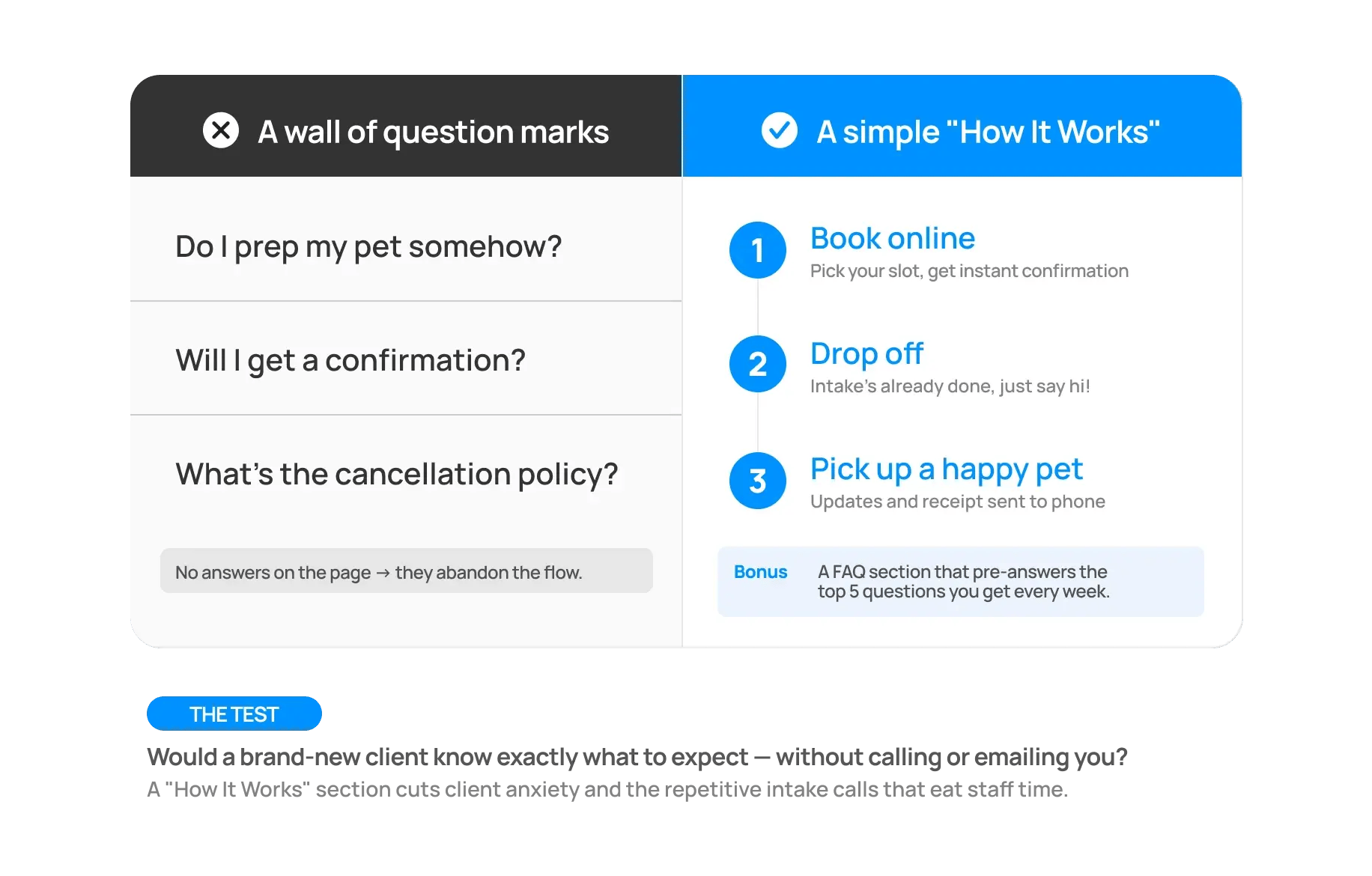
The booking click is not the finish line. A first-time client wants to know: What do I do to prepare? Will I get a confirmation? How do I communicate with you? What’s your cancellation policy?
If your website creates uncertainty about what happens after clicking “Book Now,” some people will abandon the flow and never come back.
Weak: No explanation of the intake process, no confirmation information, no FAQ.
Strong: A simple “How It Works” section (3 steps is ideal) that walks a new client from booking to drop-off to pick-up. Bonus: a FAQ section that pre-answers the top 5 questions you get every week.
What Modern Pet Parents Actually Expect
Understanding why these five questions matter requires understanding who’s asking them.
The modern pet parent skews millennial (ages 28–43), is highly likely to own a dog or cat as their primary “child” or family member, and has grown up navigating digital commerce for everything from groceries to medical appointments.
A few data points that should inform how you think about your website:
- 35–45% of all pet business website visits now happen on mobile. If your site isn’t optimized for a 6-inch screen, you’re losing nearly half your traffic before they even read your headline.
- The average attention span on a new website is about 3 seconds before a visitor decides to stay or leave.
- The benchmark this audience uses for “easy booking” isn’t your competitor down the street. It’s Uber, Amazon, and DoorDash. They expect instant confirmation, clear pricing, and a frictionless experience.
Your website doesn’t need to be beautiful. It needs to be clear and fast.
The Conversion Math: Why Small Fixes Have Big Payoffs
Most pet business owners think about a website redesign as a design project — something that costs money and takes time, with fuzzy ROI. But your website is actually a revenue system, and even small improvements to how well it converts visitors into booked appointments have compounding financial impact.
Let’s run the numbers:
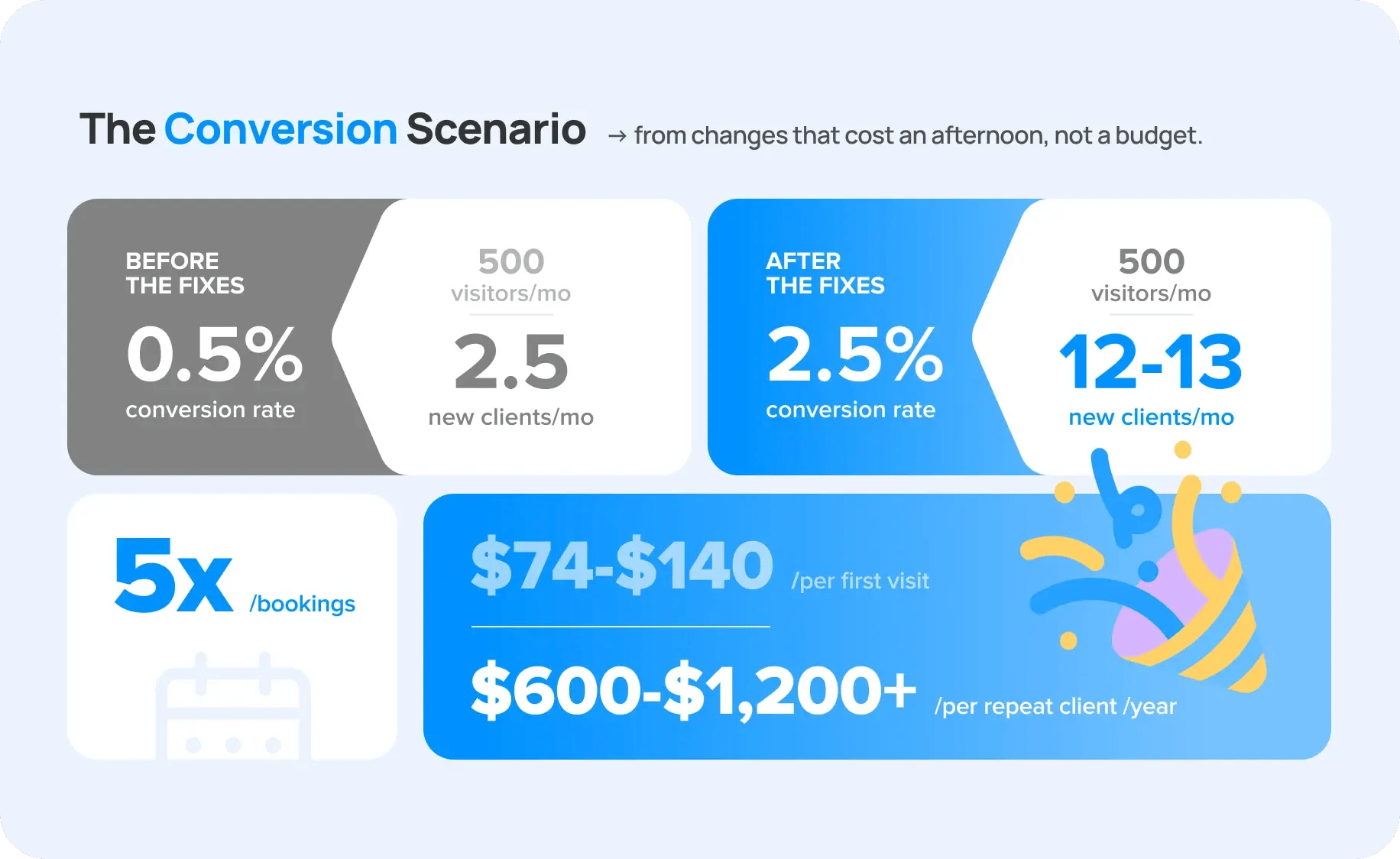
👉 The lesson: Don’t think about your website as a marketing expense. Think about it as a sales tool with a measurable conversion rate. Every improvement is an investment with a calculable return.
From Website Fix to Seamless Booking: Where MoeGo Fits
Fixing your homepage answers the five questions. But there’s a second layer to the problem: even a perfect homepage fails if what happens after the click is clunky.
Imagine a pet parent clicks “Book Now,” gets excited, fills out their info, and then receives no confirmation. Or they submit a request and wait 24 hours to hear back. Or they have to re-enter their pet’s information every single visit.
That friction is a trust-breaker. And it puts the burden back on you and your staff to manage manually.
This is where MoeGo comes in.
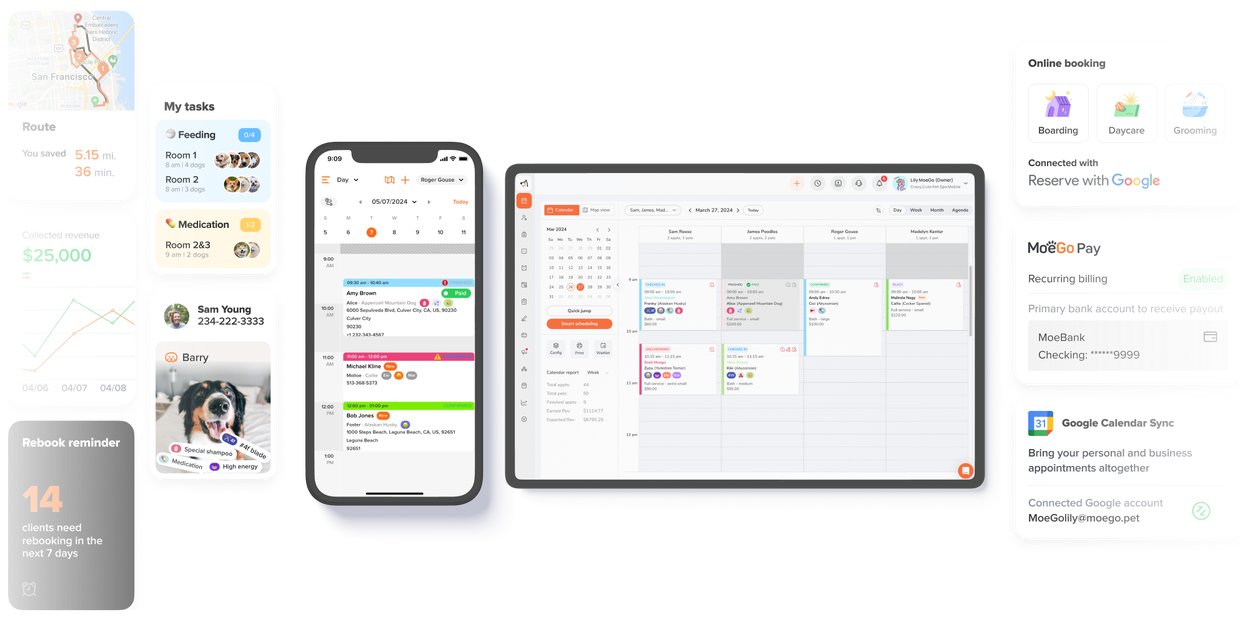
MoeGo is the operational layer that connects your website to your business, so that when a pet parent clicks “Book Now,” what happens next is just as seamless as what brought them there.
With MoeGo, pet businesses can:
- Offer 24/7 online booking that syncs directly with your calendar. No back-and-forth. No manual scheduling
- Send automatic confirmation and reminder messages so clients feel taken care of from the moment they book
- Capture new client intake forms digitally: breed, weight, vet info, vaccination records, all before they walk in the door
- Process payments seamlessly with built-in invoicing and checkout
- Build client profiles that remember pet history, preferences, and notes, so every visit feels personal
- Track your business performance with reporting that shows where your bookings are coming from and how your revenue is trending

How The Dog House DeLand made grooming instructions impossible to miss
By structuring how grooming instructions are recorded and surfaced throughout the workflow, The Dog House DeLand ensured that critical details don’t get lost between intake and execution. Now, the team works from clearly documented, consistently visible instructions at every step.
For pet businesses running on manual scheduling, phone calls, and paper intake forms, MoeGo removes the operational friction that quietly caps your growth, and replaces it with a system that works while you work (and while you sleep).
Your homepage gets them in the door. MoeGo keeps them coming back.
Rate Your Homepage: The 5-Question Self-Assessment
Use this scorecard to audit your current homepage. Be honest — this is for you.
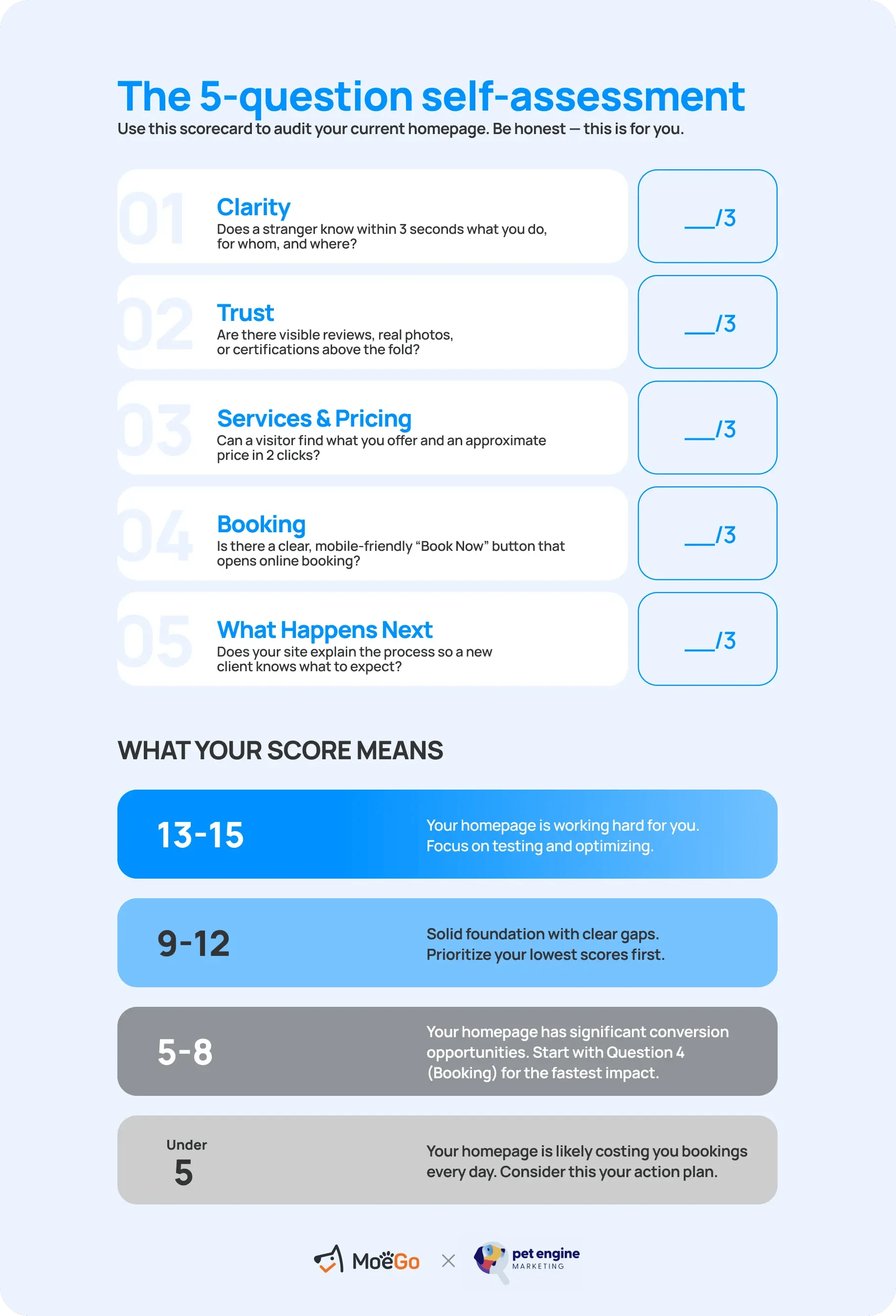
Scoring:
- 13–15: Your homepage is working hard for you. Focus on testing and optimizing.
- 9–12: Solid foundation with clear gaps. Prioritize your lowest scores first.
- 5–8: Your homepage has significant conversion opportunities. Start with Question 4 (Booking) for the fastest impact.
- Under 5: Your homepage is likely costing you bookings every day. Consider this your action plan.
Your Next Step
Run this audit today. It takes 15 minutes.
If you find gaps (most pet businesses do), start with the booking experience. It’s the highest-leverage fix, and it’s often the fastest to implement.
If you’re ready to pair a better website with an operational system that makes every booking seamless, explore what MoeGo can do for your business.

Just starting or adding to your business?
We have flexible plans meant for all stages.


Holiday Grooming Add-Ons: How to Build a Seasonal Menu That Sells Itself
How KLŌS Fine Pet Salon Turned Milton, Georgia's Most Discerning Zip Code Into Its Biggest Advantage