Share this
by MoeGo on Oct 15, 2026, 6:00:01 AM
It's 7:45 on a Monday morning. Twenty-two dogs are already in the playroom, three more are in the lobby, and your second handler just texted that she's running late. A new Lab is bouncing off a nervous terrier in the corner. The phone is ringing. You're doing math in your head: Is one person enough for this room? How about for the next ten minutes?
.webp?width=1832&height=1288&name=00-monday-morning-scene%20(1).webp)
If that scene feels familiar, you're not alone. "How many dogs per staff member?" is one of the most-asked questions in the MoeGo Community, and it almost never gets the same answer twice. Ask ten owners and you'll hear 1:5, 1:10, 1:15, and 1:20, each defended with total confidence.
The stakes are real. Run too lean and you risk a fight, an injury, or a failed inspection. Run too heavy and payroll eats your margin. And regulators are no longer waiting for the industry to agree: new rules are arriving state by state.

The short answer: 1 to 10
Most dog daycares run one staff member for every 10 to 15 dogs in group play. Premium facilities often run 1:8 or tighter, and kenneled boarding can run 1:20 or more because dogs aren't loose together. Where a law exists, 1:15 is a common legal ceiling (Colorado, Iowa) and 1:10 is the stricter one (North Carolina, and England's licensing guidance). Treat the legal number as your floor, not your target.
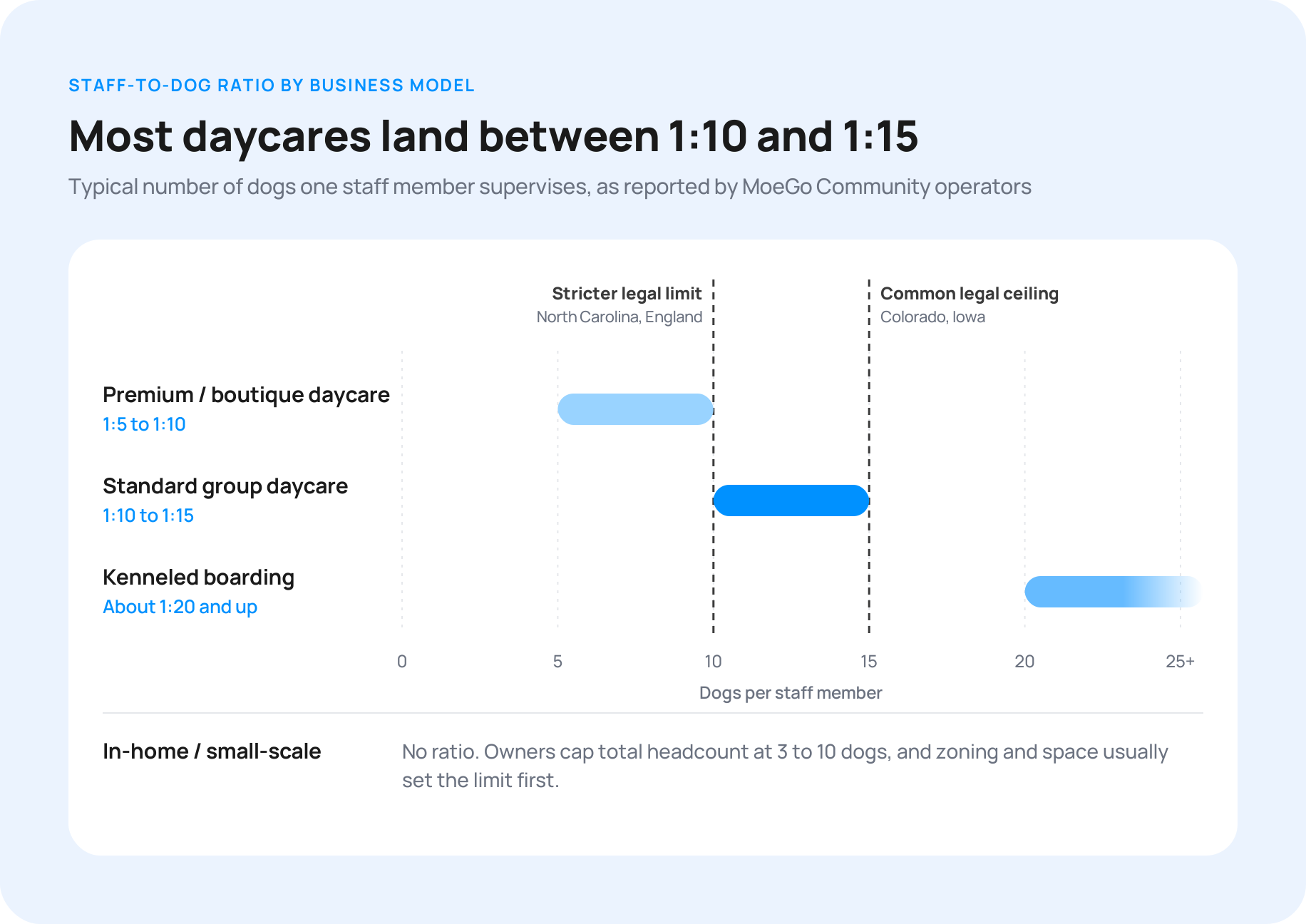
So we went to the source. We pulled every staffing-ratio discussion from the MoeGo Community over the past year, about 117 threads, and distilled them into 25 concrete statements from owners actually running the floor. Then we checked those numbers against what regulators really require. Here's what we found, broken down by business model, by law, and into a six-step method you can use.

Dog-to-staff ratio by business model
There's no single right ratio because there's no single kind of facility. When owners in our community disagreed about "the" number, it was almost always because they were running different businesses. Here's how the answers split.
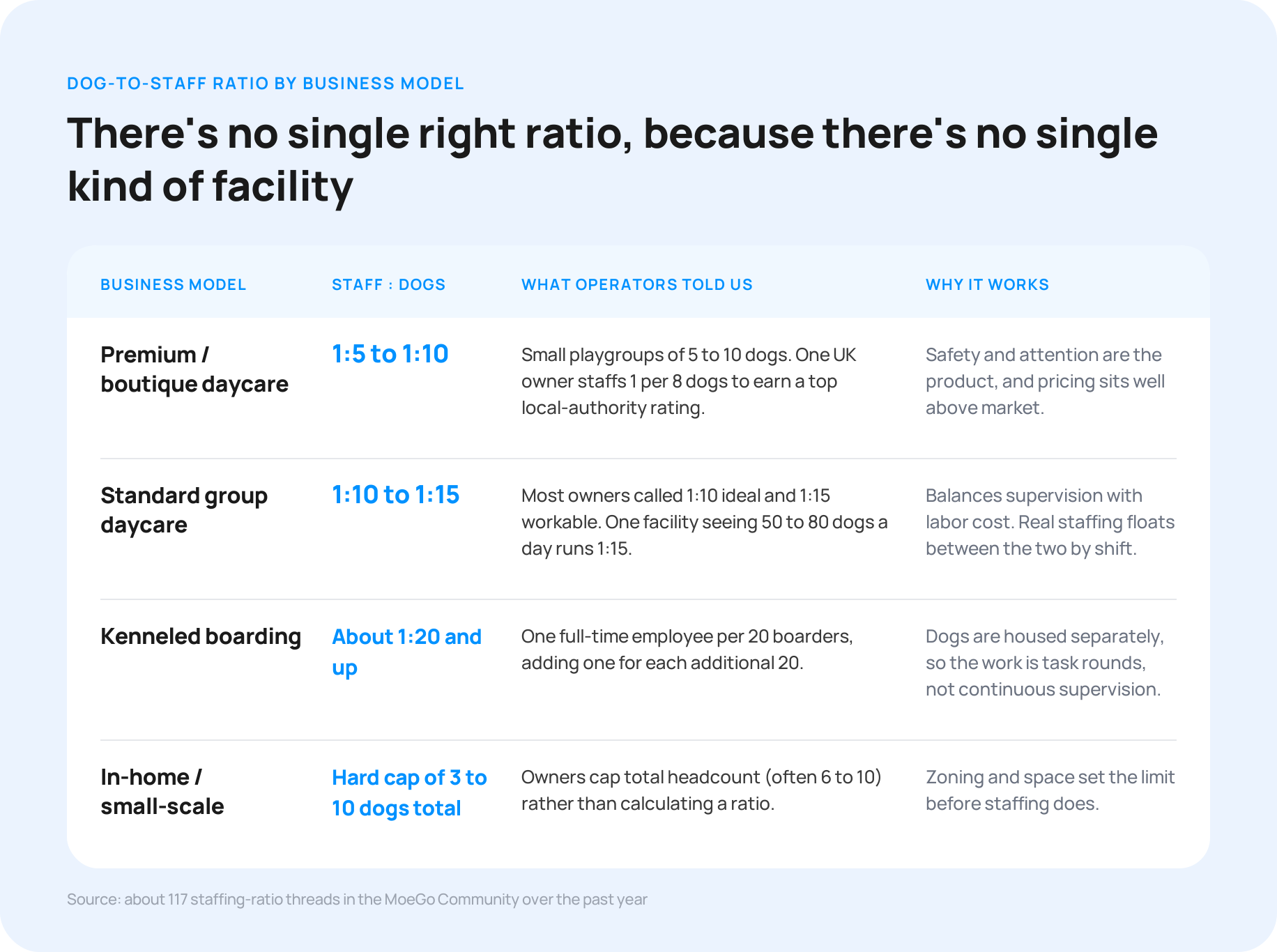
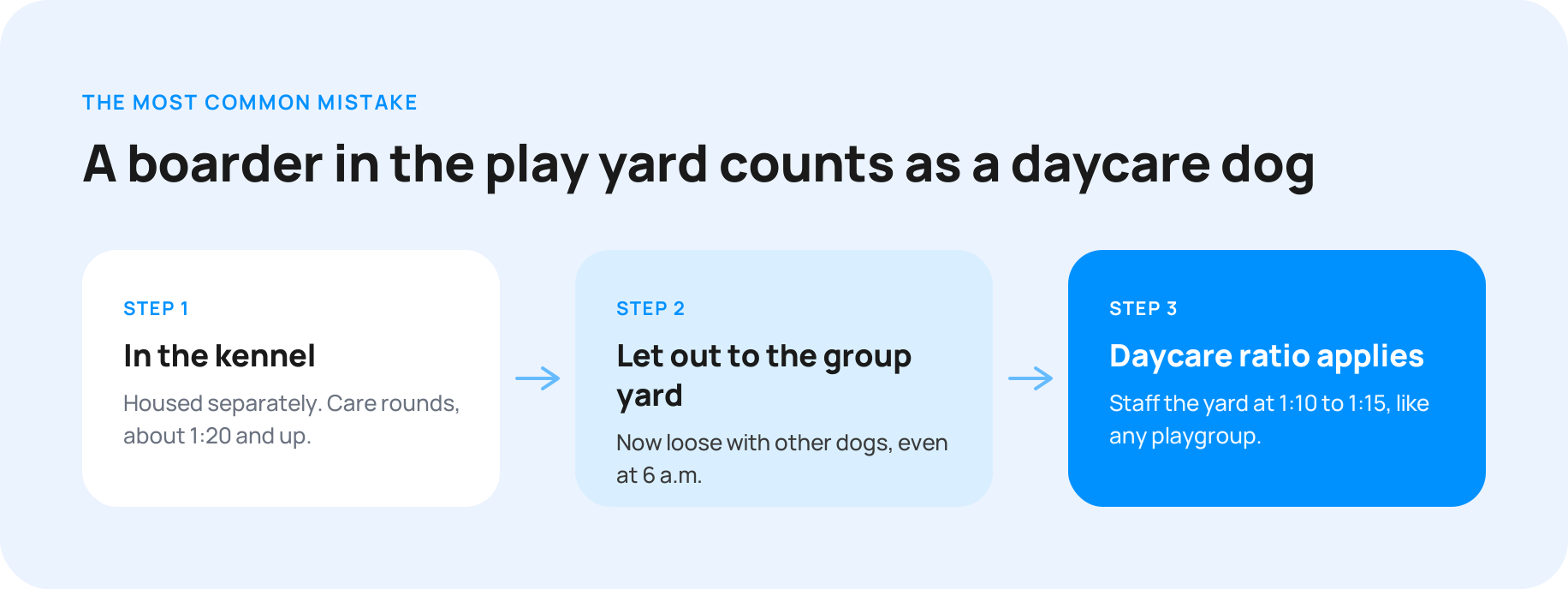
The most common mistake: using one ratio for both daycare and boarding. The moment boarders go out for group yard time, they're a playgroup, and daycare ratios apply, even at 6 a.m.
What the law says about staff-to-dog ratios
Most U.S. states don't set a daycare ratio at all, but the ones that do cluster between 1:10 and 1:15, and more states are moving toward rules. Here's where things stand in the jurisdictions owners ask about most.
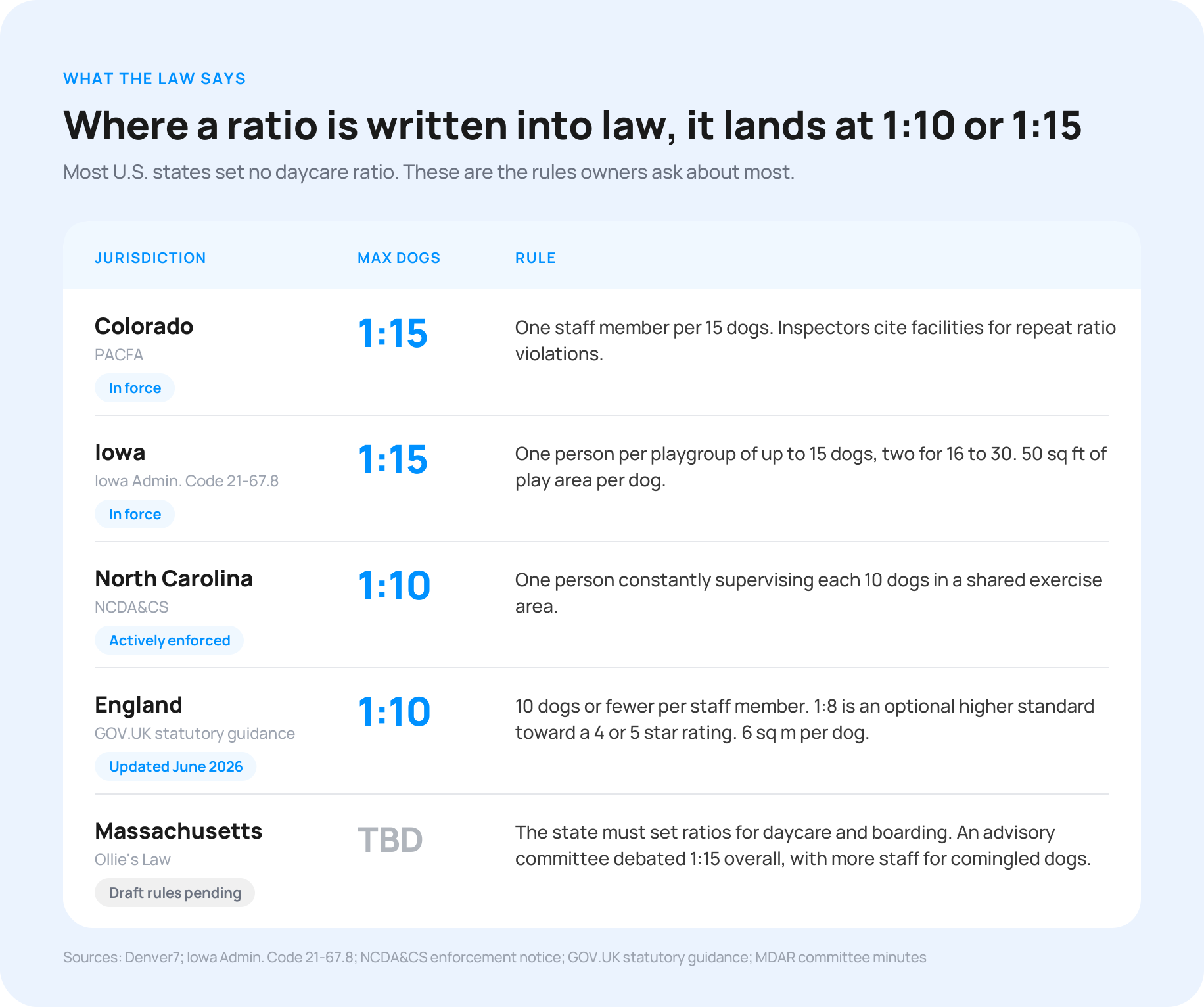
Two patterns stand out.
-
First, regulators increasingly separate comingled dogs (playgroups) from kenneled dogs, which mirrors what experienced operators already do.
-
Second, rules are tightening. In our community, a proposal for a 1:4 local ratio drew alarm from owners who said it would put many daycares out of business. Even if that number never passes, it shows how fast the ground can shift.
Check your city and county, too. Local zoning and kennel ordinances often add limits the state doesn't, especially for home-based businesses, where caps of 3 to 5 dogs are common. One community member got so tired of the recurring question that they looked up their city's municipal code and posted it for everyone. That's the right instinct: go to the primary source.
Why the ratio alone won't keep dogs safe
The most experienced owners in our community don't obsess over one number. They treat the ratio as an output of how they run the floor. Five factors came up again and again.
1. Group design matters more than total headcount. Mature facilities split dogs by size and temperament and rotate them through timed play blocks, often 20 to 40 minutes each, with fixed staff per group. One shared schedule alternated large and small dogs every 40 minutes all morning. When groups are designed well, the ratio takes care of itself.
2. Staff experience changes the math. As one owner put it, it's not an exact dog-to-human equation. A seasoned handler who reads body language early can safely manage a group that would overwhelm a new hire. Tighten ratios during onboarding and loosen them only as skills are proven.
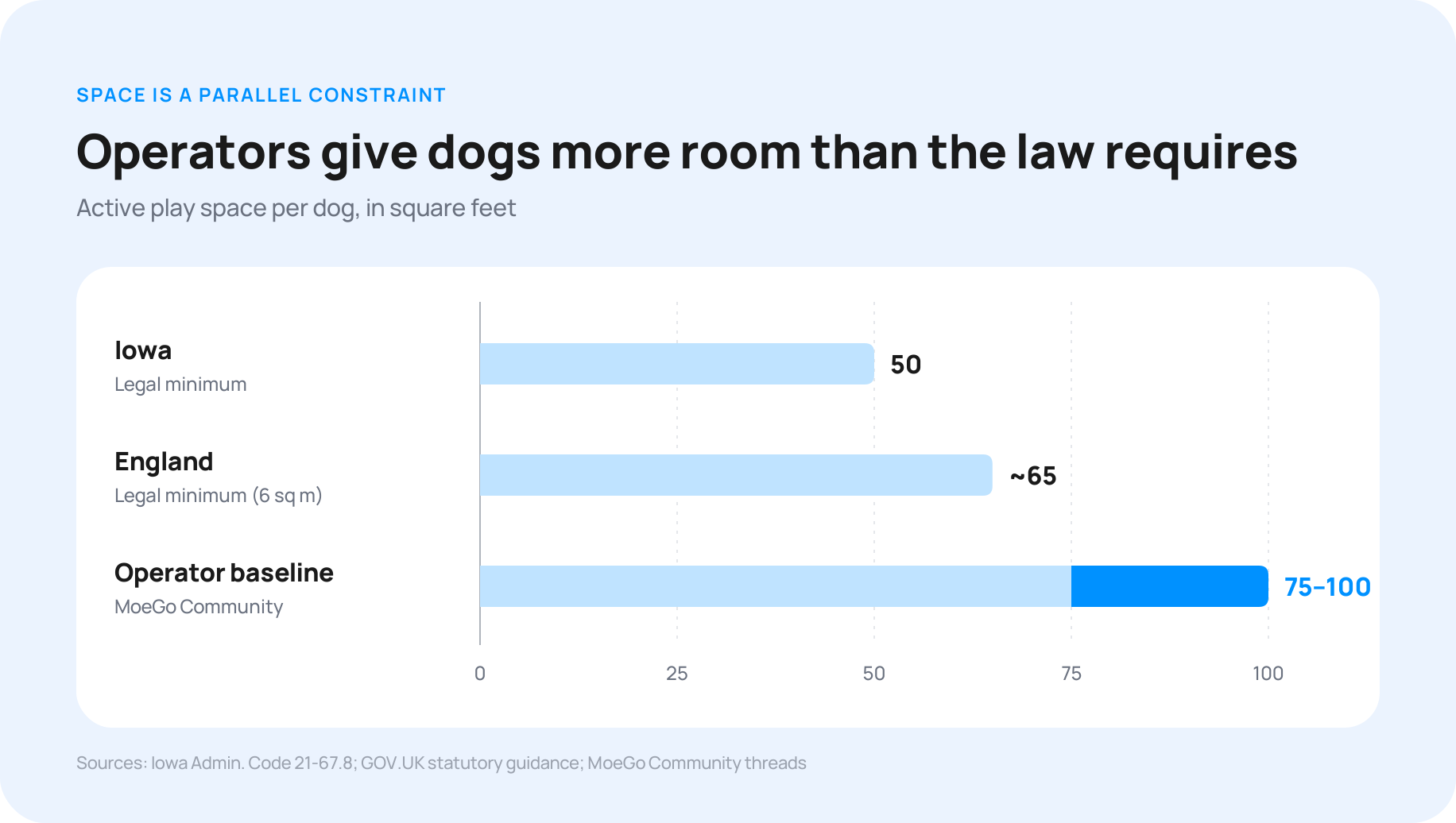
3. Space is a parallel constraint. Adding staff doesn't fix an overcrowded room. Community members cited roughly 75 to 100 sq ft per dog of active play space as a working baseline. Regulations vary widely: Iowa requires 50 sq ft, and England requires about 6 sq m (roughly 65 sq ft) per dog.
4. Peaks break ratios, not averages. Daycare load spikes at morning drop-off. If you staff to the daily average, you'll be out of ratio between 7 and 9 a.m., which is also one of the highest-risk windows of the day.
5. Saying no is part of the system. Several owners set hard daily caps (30 dogs, or even 10) and refuse bookings past them rather than risk dog or staff safety. Turning away revenue feels painful, but one serious incident costs far more.
How to set your facility's ratio in 7 steps
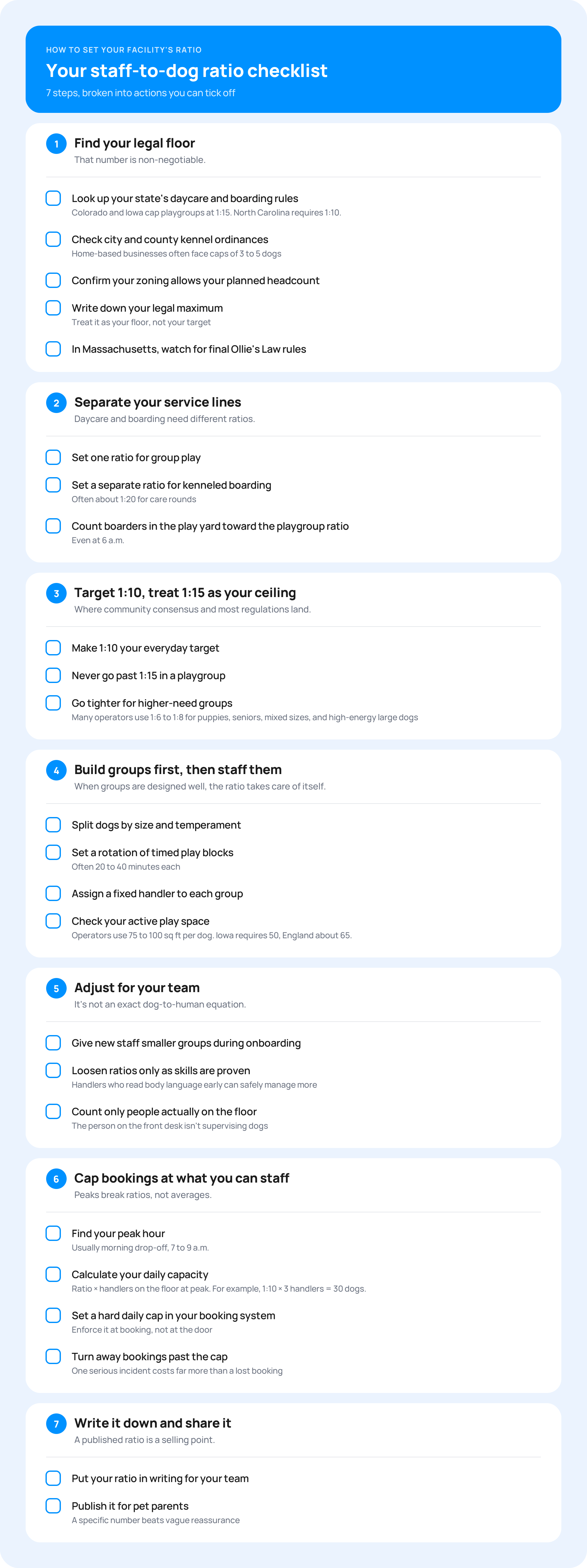
- Find your legal floor. Check state rules, city and county kennel ordinances, and zoning. That number is non-negotiable. If you're in Massachusetts, watch for final Ollie's Law rules.
- Separate your service lines. Set one ratio for group play and another for kenneled boarding. A boarding dog in a playyard counts toward the playgroup ratio.
- Target 1:10, treat 1:15 as your ceiling. That's where community consensus and most regulations land. Go tighter for puppies, seniors, mixed-size groups, and high-energy large dogs.
- Build groups first, then staff them. Design playgroups by size and temperament, set a rotation schedule, and assign a fixed handler to each group.
- Adjust for your team. New staff work smaller groups. Count only people actually on the floor; the person on the front desk isn't supervising dogs.
- Cap bookings at what you can staff. Your daily capacity is ratio times handlers on the floor at your peak hour. Enforce it at booking, not at the door.
- Write it down and share it. A published ratio is a selling point. Pet parents comparison-shop on supervision, and a specific number beats vague reassurance.
Where technology and software help
The hardest part of a ratio isn't choosing it, it's holding it every day.
That's where tools like MoeGo come in: setting daily capacity limits so you stop overbooking before it happens, seeing who's checked in by service and playgroup, and matching staff schedules to your actual peak hours. When the ratio lives in your booking system instead of a manager's head, it holds up on your busiest Monday.

MoeGo for Boarding & Daycare
See how MoeGo helps daycare and boarding facilities manage capacity and staffing

Frequently asked questions
What is the standard staff-to-dog ratio for dog daycare?
The industry standard is one staff member for every 10 to 15 dogs in supervised group play. Many operators consider 1:10 ideal and 1:15 the maximum. Premium facilities often run 1:8 or lower.
How many dogs can one person legally supervise?
It depends on where you operate. Colorado and Iowa allow up to 15 dogs per person in a playgroup. North Carolina requires one person for every 10 dogs in a shared area. England's guidance sets 10 dogs per staff member. Many U.S. states have no ratio rule, so check local ordinances.
Is the ratio different for dog boarding?
Yes. Kenneled boarding dogs are housed separately, so facilities often staff around one person per 20 dogs for care rounds. Once boarders are let out together for group play, daycare ratios apply.
Does the front desk person count toward the ratio?
No. Only staff actively supervising dogs on the floor should count. Someone checking in clients or answering phones can't respond to a scuffle in the playroom.
What ratio should I use for puppies or mixed-size groups?
Go tighter than your standard. Many operators use roughly 1:6 to 1:8 for puppies, seniors, and groups mixing large and small dogs, since these groups need closer attention.
How much space does each dog need in daycare?
Operators commonly use 75 to 100 sq ft of active play space per dog. Legal minimums vary: Iowa requires 50 sq ft per dog, and England requires 6 square meters (about 65 sq ft).

Just starting or adding to your business?
We have flexible plans meant for all stages.

How Many Dogs Per Staff Member? The Pet Daycare & Boarding Ratio Guide (2027)

From Pet Professional to CEO: How One Business Owner Took a 2-Week Vacation Without Her Business Falling Apart
