Share this
by MoeGo on Nov 24, 2026, 9:31:26 PM
It's a scene boarding and daycare owners describe again and again. A friendly new client books a two-week holiday stay and pays up front. Then the records arrive: no distemper or parvo shots, just a lab report of antibody levels. "Well, it's my right," the client says. One facility owner who asked their state inspector about this got a blunt answer: titers can't be accepted.
Every daycare and boarding owner ends up writing a vaccine policy, and most rewrite it after a hard conversation like this one. The stakes are high. One unvaccinated dog can bring parvo or distemper into a room of 40. One expired rabies certificate can put your license at risk. And every exception you make becomes the next client's argument.
It's also one of the most-asked questions among daycare and boarding owners. We analyzed nearly 100 conversations among daycare and boarding owners and almost 1,000 of their responses about which vaccines to require, titers, boosters, and clients who refuse. Here's what boarding and daycare owners require, what veterinary guidelines and state rules say, and how to enforce a policy without arguing at the front desk.

Most dog daycares and boarding kennels require rabies, DHPP, and Bordetella
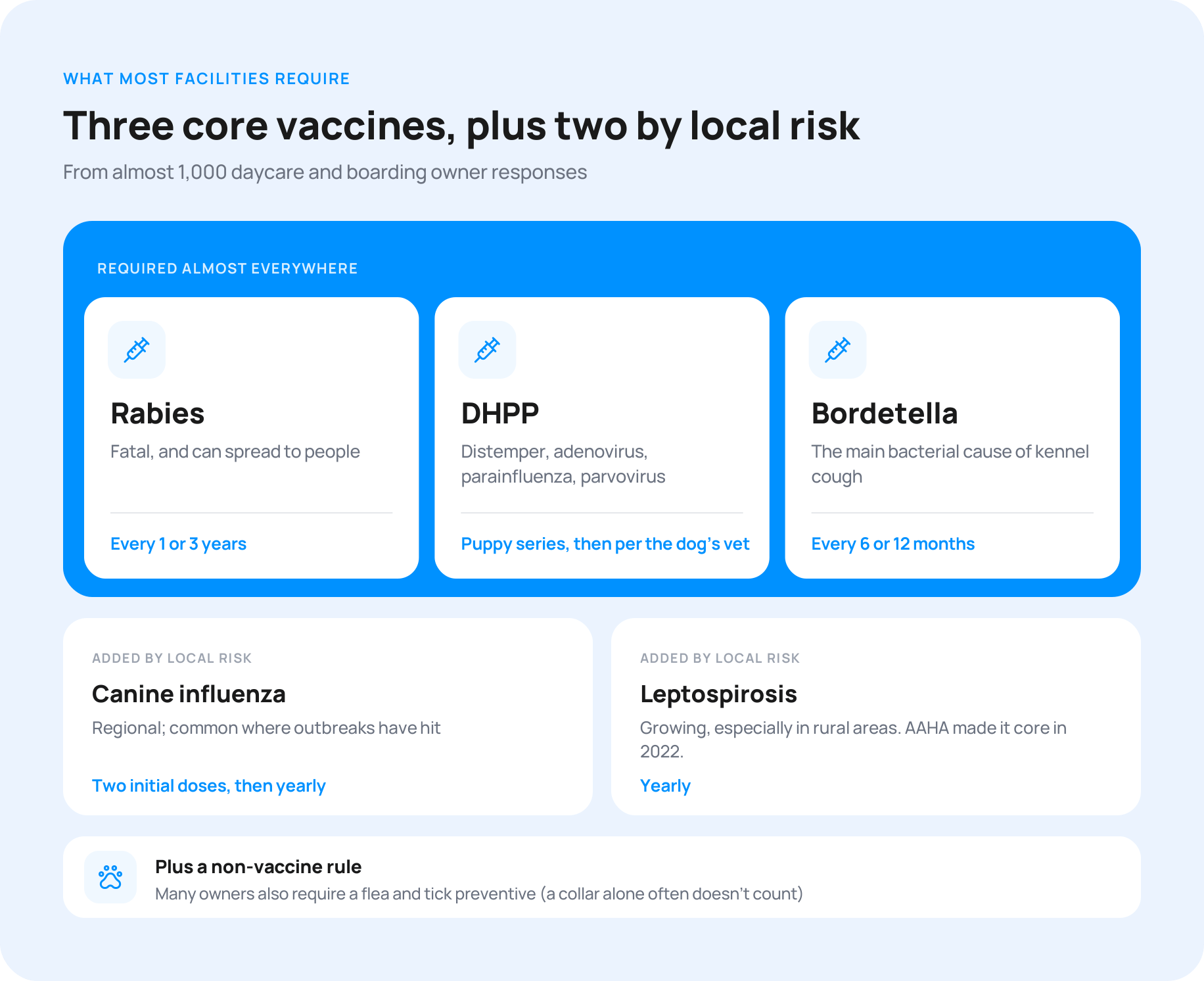
Most dog daycare and boarding facilities require three vaccines: rabies, DHPP (distemper, hepatitis/adenovirus, parainfluenza, and parvovirus), and Bordetella.
Canine influenza and leptospirosis are added based on local risk. Don't accept titers in place of rabies vaccination.
Whether titers can replace DHPP depends on your state rules and your own risk tolerance.
Which vaccines boarding and daycare owners require
The same three vaccines show up in almost every facility's policy. Beyond those, requirements depend on your region and how much risk you want to carry.
|
Vaccine |
Protects against |
How common among facilities |
Booster and timing notes |
|
Rabies |
Rabies, a fatal disease that can spread to people |
Near-universal; many tie it to their license |
Every 1 or 3 years, depending on the vaccine and local law |
|
DHPP (also DAPP or DA2PP) |
Distemper, adenovirus/hepatitis, parainfluenza, parvovirus |
Near-universal |
Puppy series, then boosters per the dog's vet |
|
Bordetella |
The main bacterial cause of kennel cough |
Near-universal, though a few facilities don't require it |
Facilities are split between every 6 months and every 12 months |
|
Canine influenza (H3N2/H3N8) |
Dog flu |
Regional; common where outbreaks have hit |
Two initial doses, then yearly; full immunity takes weeks |
|
Leptospirosis |
A bacterial disease that also infects people |
Growing, especially in rural areas |
Yearly |
Veterinary guidance is moving in the same direction. The American Animal Hospital Association's 2022 canine vaccination guidelines changed leptospirosis from non-core to core (AAHA). Some boarding and daycare owners now require it. Others offer a waiver because lepto is the vaccine pet parents and vets worry about most for reactions.
Many boarding and daycare owners add a non-vaccine rule: dogs must be on a flea and tick preventive (a collar alone often doesn't count), and some require current deworming.
Bordetella: every 6 months or every year?
This is the most common booster question. Some boarding and daycare owners require Bordetella every 6 months. Others accept a yearly shot, and many simply say "whatever the dog's vet recommends, 6 or 12 months." The American Kennel Club notes Bordetella boosters are typically given yearly, with some vets recommending 6 months for high-risk dogs (AKC).
Be honest with clients about what it does. Kennel cough has at least 12 possible causes, and the Bordetella vaccine targets one of them. It reduces how sick a dog gets but doesn't guarantee a dog won't catch it (AKC). One facility owner saw this firsthand: after a kennel cough outbreak, vaccinated dogs recovered quickly while unvaccinated dogs got very sick. They made Bordetella mandatory for every dog.
A small number of facilities don't require Bordetella at all. They require every client to sign a release acknowledging that contagious illness is a risk of group care. Either way, put that acknowledgment in your terms.
How far in advance should vaccines be given?
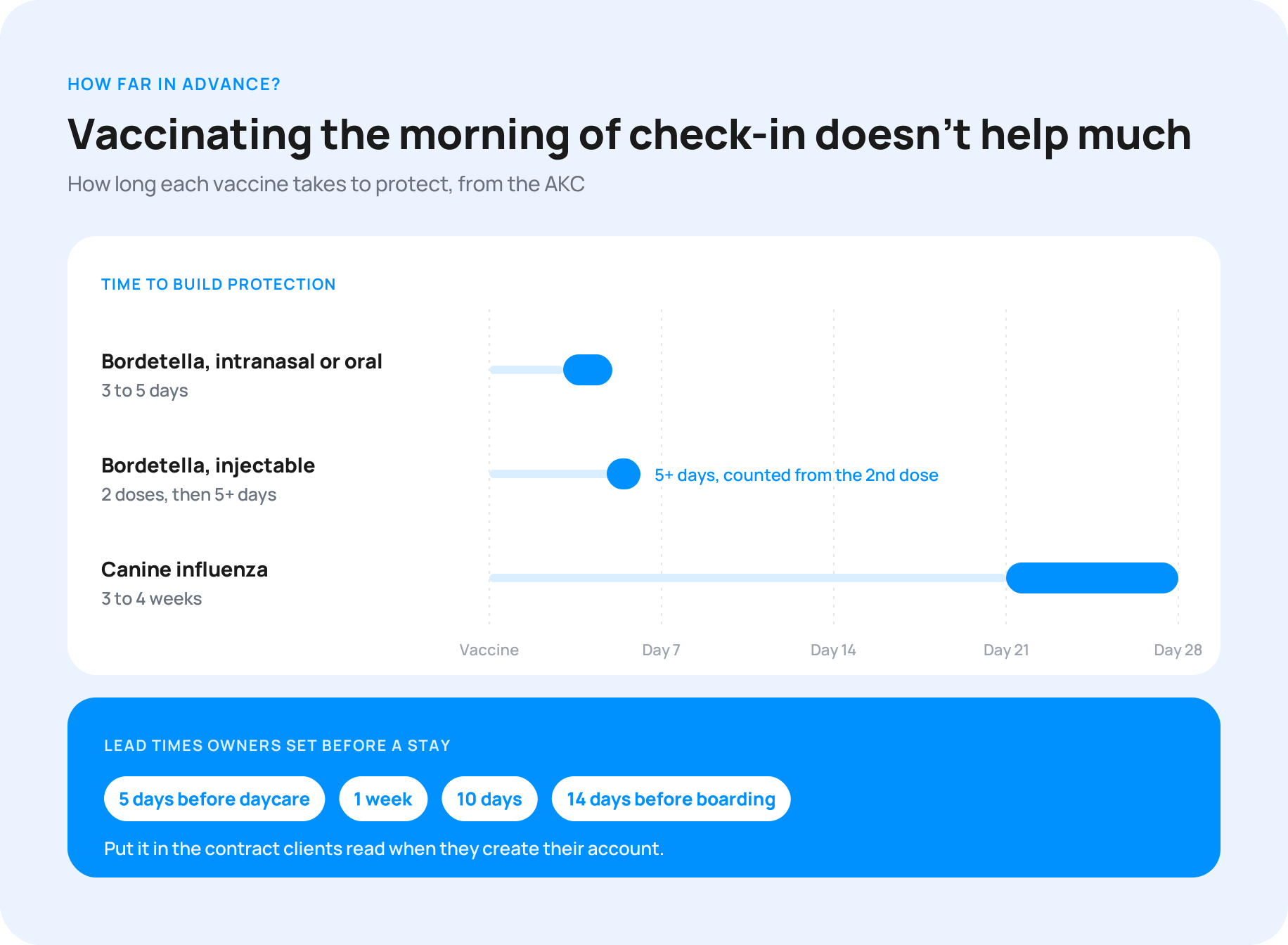
Vaccinating the morning of check-in doesn't help much. Intranasal and oral Bordetella vaccines usually protect within 3 to 5 days, while injectable versions need two doses and take at least 5 days after the second (AKC). Canine influenza vaccines take 3 to 4 weeks to build immunity (AKC).
Boarding and daycare owners set their own lead times: at least 5 days before daycare, 1 week, 10 days, or 14 days before boarding. Some also worry about live intranasal vaccines briefly shedding. One facility owner said the only kennel cough case they ever had came in with a freshly vaccinated dog. Another facility owner who used to require vaccines just one week out got calls about kennel cough when no other dogs in their care were sick.
The practical problem is compliance. Clients book late and vaccinate late. Facility owners who make it work put the lead time in the contract clients read when they create their account, and stop taking last-minute bookings that don't meet it.
Puppies
Boarding and daycare owners typically want at least two rounds of DHPP plus Bordetella before a puppy boards, with minimum ages from 12 to 16 weeks. Some are flexible on rabies for young puppies, because local vets often give it later.
Puppies get extra care: their own disinfected space, no shared yard time, and staff who sanitize hands before handling them.
Facility owners disagree on vaccines a breeder or pet parent gave at home. Some accept them with the vaccine labels attached and report no problems in decades. Others refuse, since there's no way to know how the vaccine was stored or given.
Do you have to accept titers?
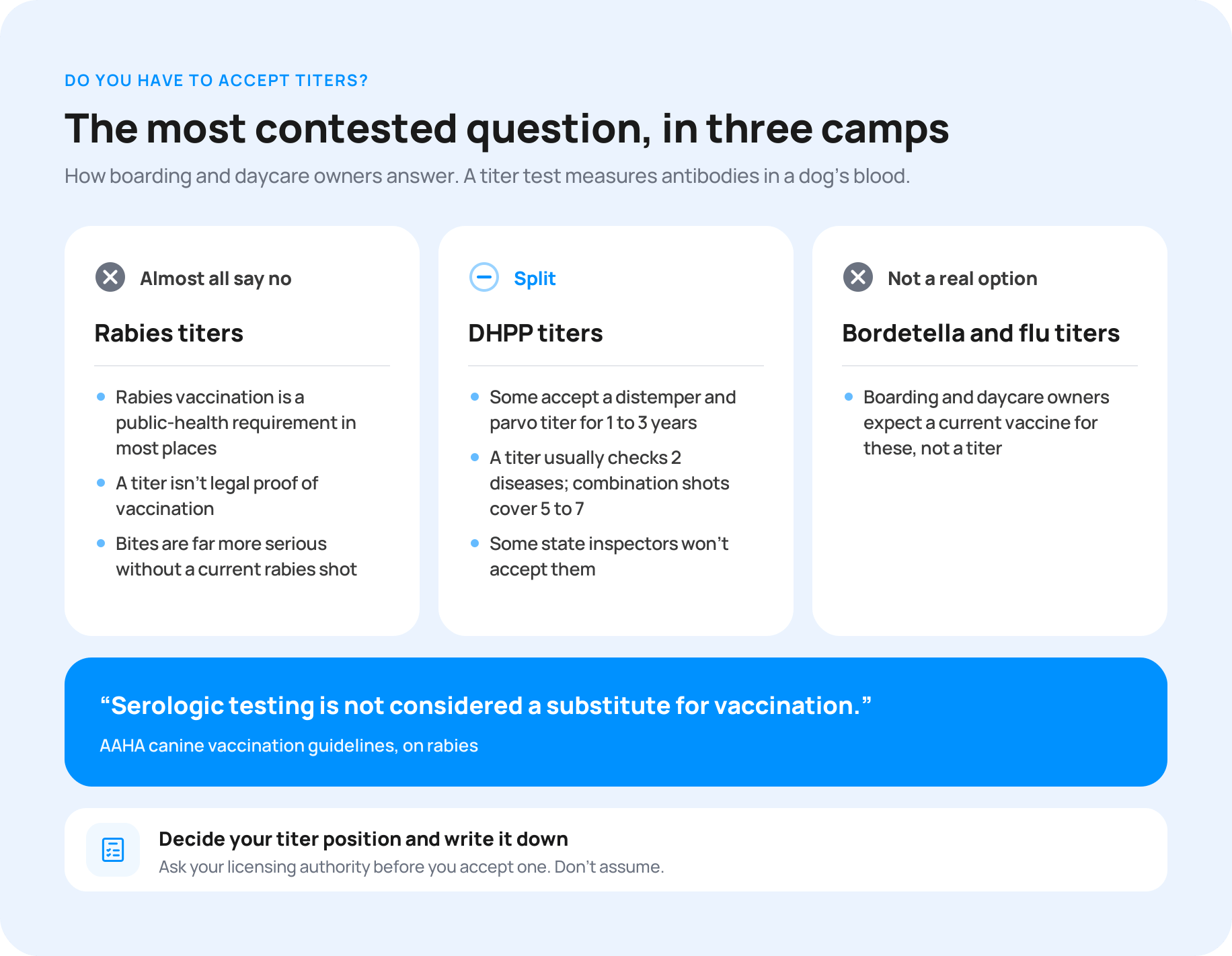
This is the most contested question in our research. A titer test measures antibodies in a dog's blood. Some clients prefer it to repeat vaccination. Boarding and daycare owners fall into three camps.
Rabies titers: almost everyone says no. Rabies vaccination is a public-health requirement in most places, and a titer isn't legal proof of vaccination. AAHA's guidelines state that "serologic testing is not considered a substitute for vaccination" for rabies (AAHA). Facility owners also point to bites: if a dog without a current rabies vaccine bites someone in your care, the consequences are far more serious. See our dog daycare bite protocol.
DHPP titers: facilities are split. Some accept a titer for distemper and parvo, valid for 1 to 3 years. Others refuse, and they have reasons:
- AAHA notes that a titer "is not necessarily indicative of protection or susceptibility" and sets no "protective" values (AAHA).
- Combination vaccines cover 5 to 7 diseases. A titer usually checks only distemper and parvo.
- Some regulators won't accept them. One facility owner's state inspector said plainly that titers cannot be accepted.
Bordetella and flu titers: not a real option. In our research, boarding and daycare owners expected a current vaccine for these, not a titer.
Our advice: decide your titer position, write it down, and ask your licensing authority before you accept one. Don't assume.
Medical exemptions
Some dogs can't be vaccinated safely, for example dogs with autoimmune disease. Many boarding and daycare owners accept a written exemption from the dog's veterinarian instead of a titer. At least 16 states allow medical exemptions from rabies vaccination, each with its own process (Animal Legal & Historical Center).
An exemption protects that dog. It doesn't protect the other dogs in your building. Colorado's rules make this explicit: an exempted dog can't mix with other dogs (Denver7). Some accept an exemption only for a dog they know well, and consider keeping exempt dogs out of group play.

What the rules require
Many boarding and daycare owners believe rabies vaccination is required by law in all 50 states. It isn't quite true. About ten states have no statewide requirement, though counties and cities often set their own (Animal Legal & Historical Center). States that license kennels often write vaccine rules into the license itself.
|
Jurisdiction |
Requirement |
Source |
|
Colorado (boarding, daycare, grooming, shelters) |
Facilities must keep records of current rabies (pets over 16 weeks) and distemper and parvovirus (dogs over 8 weeks). Exemption only with a vet's statement; exempted dogs can't mix with other dogs. In effect since July 15, 2025. |
|
|
Illinois (licensed kennels) |
Dogs must have proof of distemper vaccination and comply with the state's rabies law. A vet's written recommendation can exempt a dog from distemper. |
|
|
Rabies laws, all states |
About ten states have no statewide dog rabies requirement; at least 16 allow medical exemptions |
Check your state and local rules. This guide isn't veterinary or legal advice. Confirm your policy with your veterinarian and your licensing authority.
How to set and enforce your vaccine policy
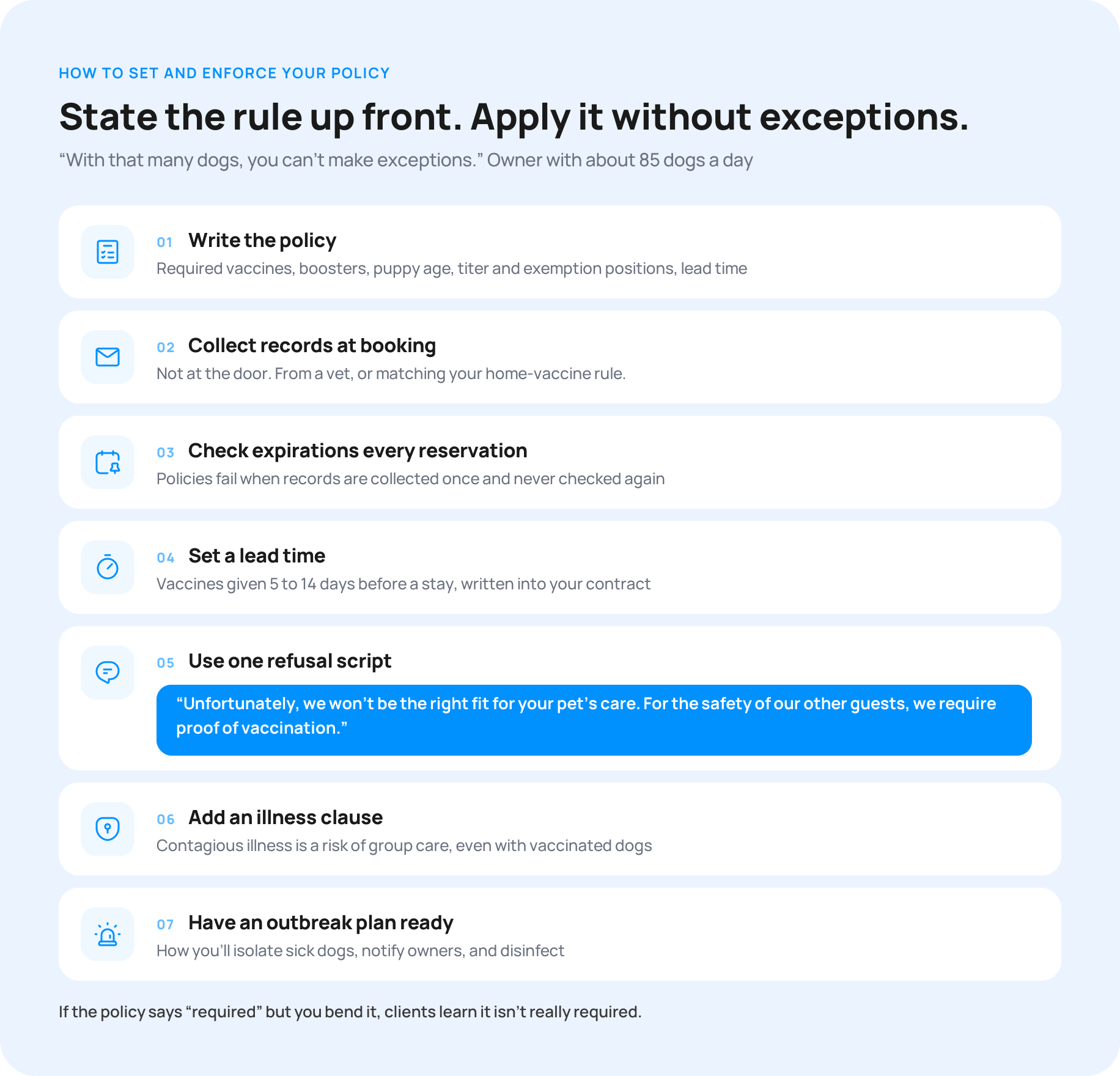
Boarding and daycare owners who report the least friction state the rule up front and apply it without exceptions. As one facility owner with about 85 dogs a day put it, with that many dogs you can't make exceptions.
- Write the policy. List required vaccines, booster intervals, minimum puppy age, your titer and exemption positions, and the lead time before a stay.
- Collect records at booking, not at the door. New clients send vet records when they request their first reservation. Records must come from a veterinarian or match your home-vaccine rule.
- Check expiration dates before every reservation. Policies most often fail when records were collected once and never checked again.
- Set a lead time. Require vaccines to be given 5 to 14 days before daycare or boarding, and put it in your contract.
- Use one refusal script. For example: "Unfortunately, we won't be the right fit for your pet's care. For the safety of our other guests, we require proof of vaccination."
- Add an illness clause to your terms. Clients acknowledge that contagious illness is a risk of group care, even with vaccinated dogs.
- Have an outbreak plan ready. Vaccines don't stop every illness. Know how you'll isolate sick dogs, notify pet parents, and disinfect. See our guide to cleaning a dog daycare or boarding facility.
Why no exceptions? An expired rabies certificate can put your state license at risk. And if your policy says "required" but you bend it, clients learn it isn't really required.
Catch expired vaccines before check-in
The weak point in most vaccine policies isn't the rule. It's checking records every time. In MoeGo, you set required vaccines by care type, and each pet's records carry an expiration date and the vet certificate. Appointment cards show a vaccine alert: red when a required vaccine is missing or will expire by the appointment date, yellow when one expires within 30 days (see how it works). Clients can upload updated records through the online booking client portal, and your team reviews them before they go live.
Frequently asked questions
What vaccines does a dog need for daycare or boarding?
Most facilities require rabies, DHPP (distemper, adenovirus, parainfluenza, parvovirus), and Bordetella. Some also require canine influenza or leptospirosis, depending on local risk. Always check the facility's written policy.
Should a dog daycare accept titers instead of vaccines?
Not for rabies: a titer isn't legal proof of rabies vaccination, and veterinary guidelines say serologic testing is not a substitute. For distemper and parvo, it's a business decision. Some facilities accept titers for 1 to 3 years, while others refuse because a titer doesn't prove protection. Check your state's licensing rules first.
How often do dogs need the Bordetella vaccine for boarding?
Facilities require it every 6 or 12 months. Boosters are typically yearly, and some vets recommend 6 months for higher-risk dogs, such as frequent daycare dogs. Many facilities accept whatever interval the dog's veterinarian recommends.
How long before boarding should a dog get the Bordetella vaccine?
Intranasal and oral vaccines usually protect within 3 to 5 days. Injectable versions need two doses and at least 5 days after the second. Many facilities require vaccines at least 5 to 14 days before a stay.
Can a vaccinated dog still get kennel cough?
Yes. Kennel cough has many causes, and the Bordetella vaccine targets one of them. It reduces severity and spread but can't prevent every case, so facilities add an illness-risk clause to their terms.
Do I have to board a dog with a medical exemption?
No. Many states allow vet-signed exemptions from rabies vaccination, but you can set your own acceptance policy. In some states, such as Colorado, exempted dogs can't mix with other dogs.

Just starting or adding to your business?
We have flexible plans meant for all stages.

How to Clean a Dog Daycare or Boarding Facility: The 2027 Guide
Vaccine Requirements for Dog Daycare and Boarding: The 2027 Guide