Share this
by MoeGo on Nov 24, 2026, 9:31:45 PM
The boarding owner did everything they knew to do. When a litter of puppies on their property tested positive for parvo, they isolated them, disinfected the kennels, floors, and laundry, and bleached the gravel run. Their boarding dogs were fully vaccinated and had never shared space with the puppies. Still, they couldn't sleep. How do you disinfect a yard? And how do you make sure it never happens again?
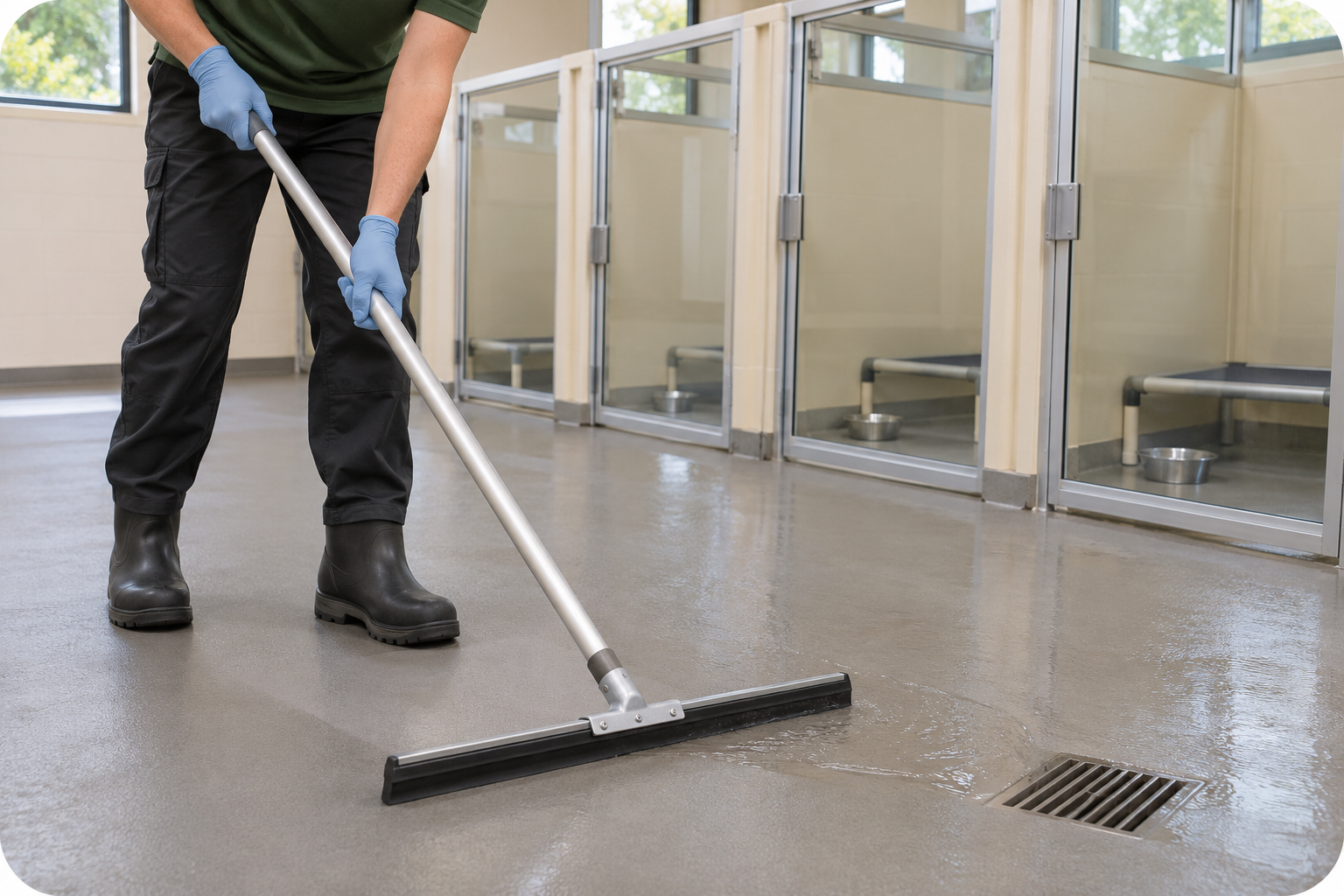
Cleaning is the part of the job nobody posts about on social media, but it's the one that keeps your business open. One missed step can spread illness through every dog in your care. One wrong product can leave dogs coughing or your floors ruined. And a facility that smells like urine loses clients before they reach the front desk.
It's also one of the most-asked questions among daycare and boarding owners. We analyzed 122 conversations among daycare and boarding owners and 859 of their responses about disinfectants, parvo, odor, and daily routines. Here's what works, what the science says, and a routine your team can actually stick to.

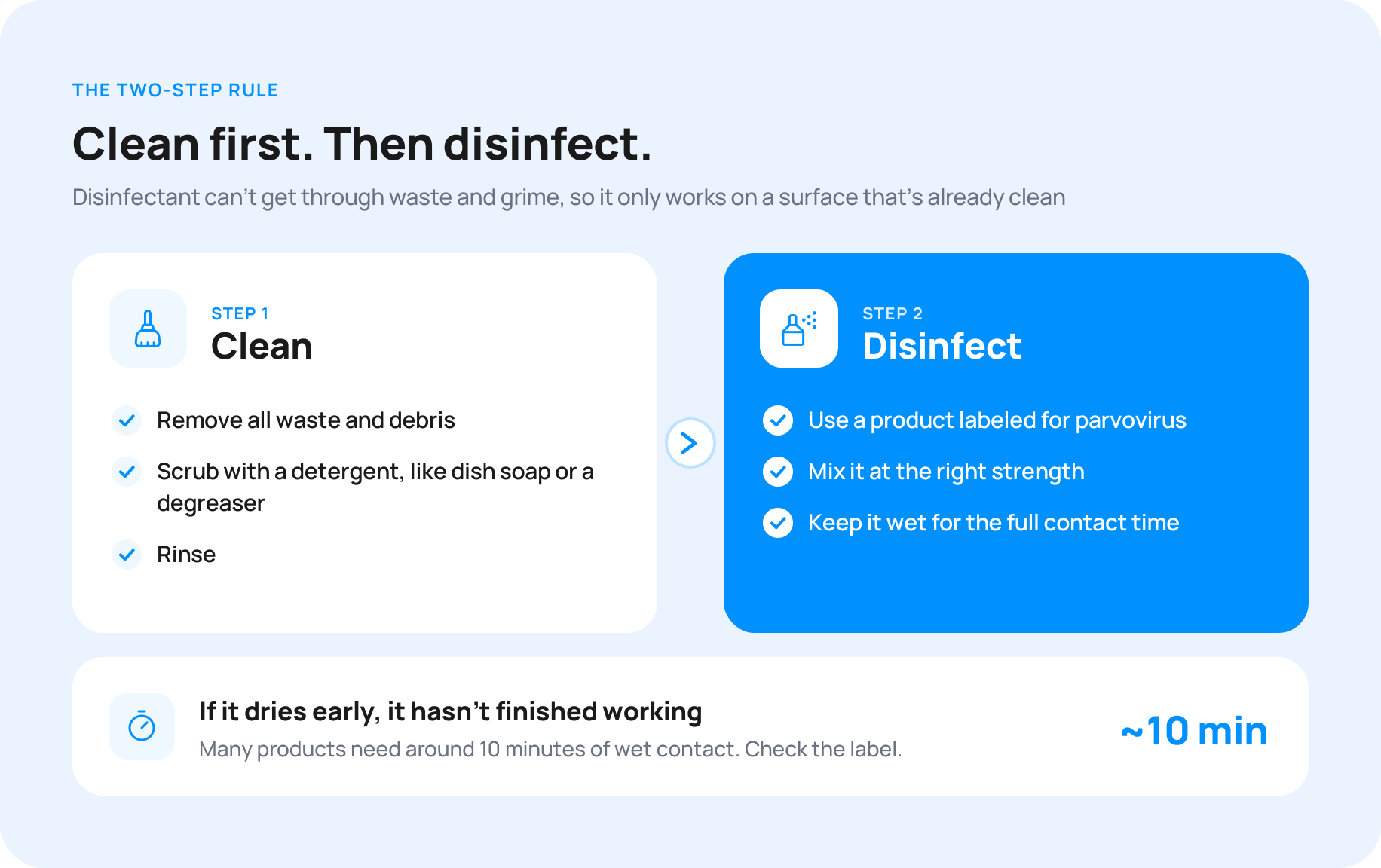
Clean first, then disinfect with a parvo-rated product at the right strength
The safest dog daycare and boarding cleaning protocol has two separate steps: remove all waste and scrub with a detergent, then apply a disinfectant labeled for parvovirus and leave it wet for the full contact time on the label.
Accelerated hydrogen peroxide is the product most owners and shelter-medicine guides favor. Many common kennel cleaners, including most quaternary ammonium ("quat") products, are not reliable against parvo, and bleach stops working when any waste is left on the surface.
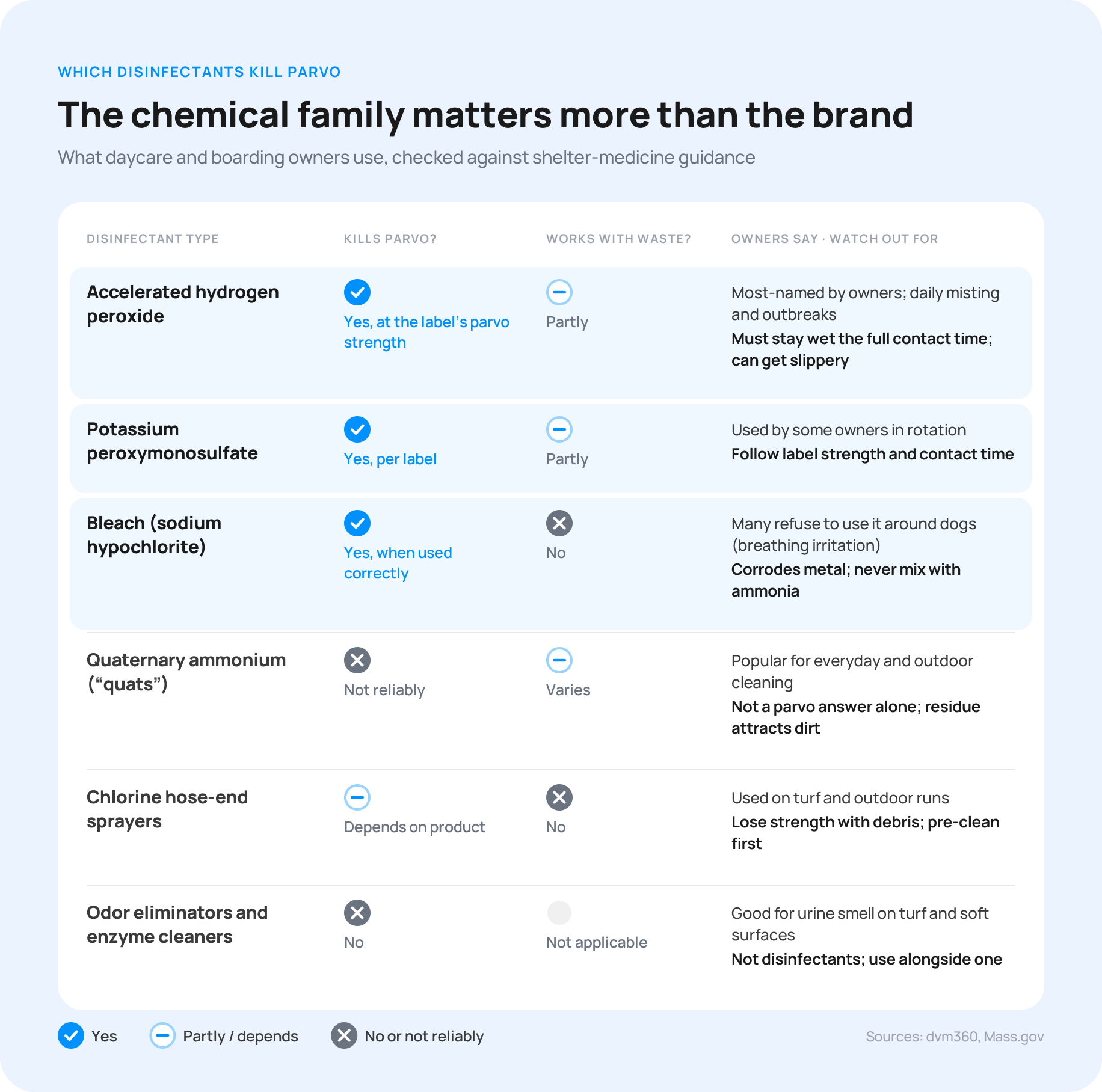
Which disinfectants owners use, and which ones kill parvo
Owners in our research named more than a dozen products, but they fall into a few chemical families. The family matters more than the brand, because it decides what the product can and can't kill.
|
Disinfectant type |
Kills parvo? |
Works with some waste present? |
What owners say |
Watch out for |
|
Accelerated hydrogen peroxide |
Yes, at the label's parvo strength |
Partly, it has detergent properties |
The most-named product family; used for daily misting and outbreaks |
Must stay wet for the full contact time; can get slippery on floors |
|
Potassium peroxymonosulfate |
Yes, per label |
Partly, it has detergent properties |
Used by some owners in rotation |
Follow label strength and contact time |
|
Bleach (sodium hypochlorite) |
Yes, when used correctly |
No, any waste on the surface stops it |
Many owners refuse to use it around dogs, citing breathing irritation |
Corrodes metal; never mix with ammonia or other cleaners |
|
Quaternary ammonium ("quats") |
Not reliably |
Varies by product |
Popular for everyday and outdoor cleaning; some dislike the residue |
Not a parvo answer on its own; residue attracts dirt and hair |
|
Chlorine-based hose-end sprayers |
Depends on product |
No |
Used on turf and outdoor runs |
Lose strength when debris is present; pre-clean first |
|
Odor eliminators and enzyme cleaners |
No |
Not applicable |
Good for urine smell on turf and soft surfaces |
Not disinfectants; use alongside one, not instead |
Shelter-medicine guidance backs up what experienced owners do. Veterinary sources describe quats as "not reliably effective" against parvovirus, and note that bleach won't work if any organic debris is present (dvm360). Massachusetts public-health guidance calls accelerated hydrogen peroxide the current best recommendation (Mass.gov).
Strength matters more than brand
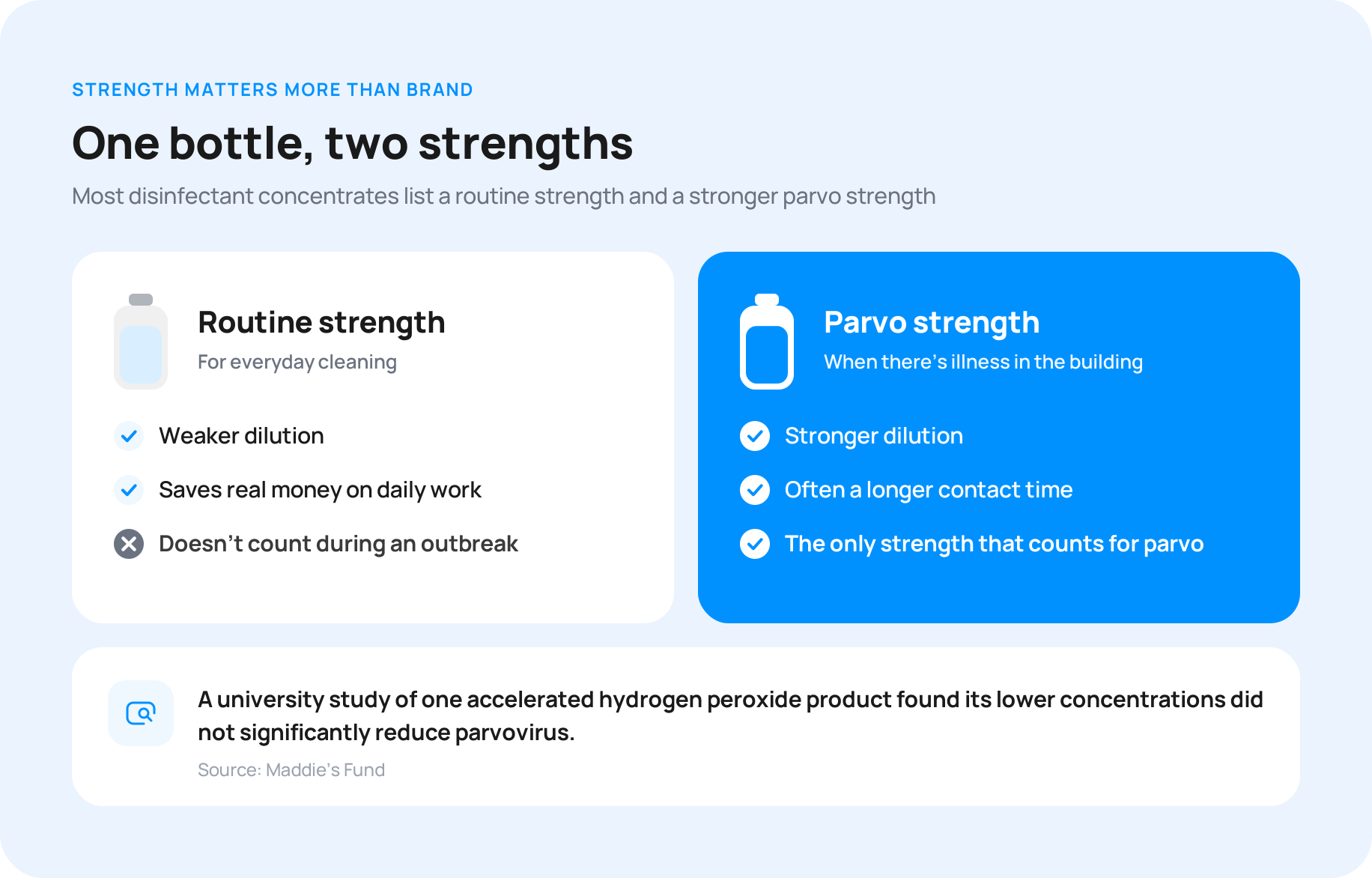
Most disinfectant concentrates list two strengths: a weaker one for routine cleaning and a stronger one, often with a longer contact time, for parvo.
Owners point out that using the routine strength every day saves real money. That's fine for daily work, but only the stronger strength counts during an outbreak. A university study of one accelerated hydrogen peroxide product found that its lower concentrations did not significantly reduce parvovirus (Maddie's Fund).
Why owners are moving away from bleach
Bleach is cheap, and it does kill parvo on a clean surface.
But owners in our research were blunt about it: it irritates dogs' noses and lungs, it's harsh on staff, and it fails on any surface with waste left behind. One owner noted that ammonia is in urine, so ammonia-based cleaners can trigger dogs to mark more.
And bleach mixed with ammonia releases toxic gas. Keep them in separate buildings if you can.
What a realistic daily routine looks like
The best routines owners described are short, fixed, and repeated, not occasional deep cleans:
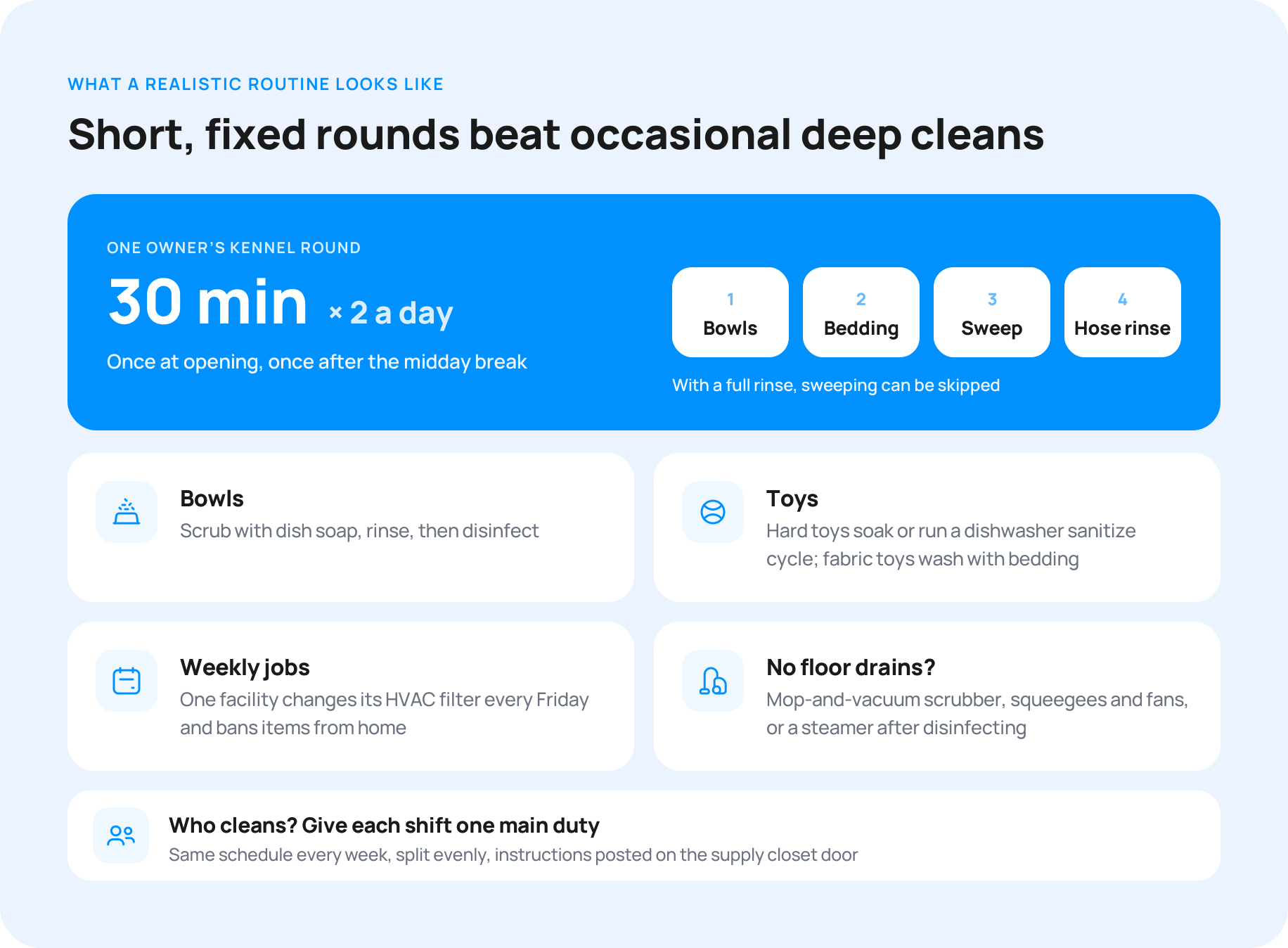
- One owner's kennel round takes about 30 minutes, twice a day, once at opening and once after the midday break. Pick up and wash bowls, refresh or wash bedding, sweep, then rinse the building with a hose. With a full rinse, sweeping can be skipped.
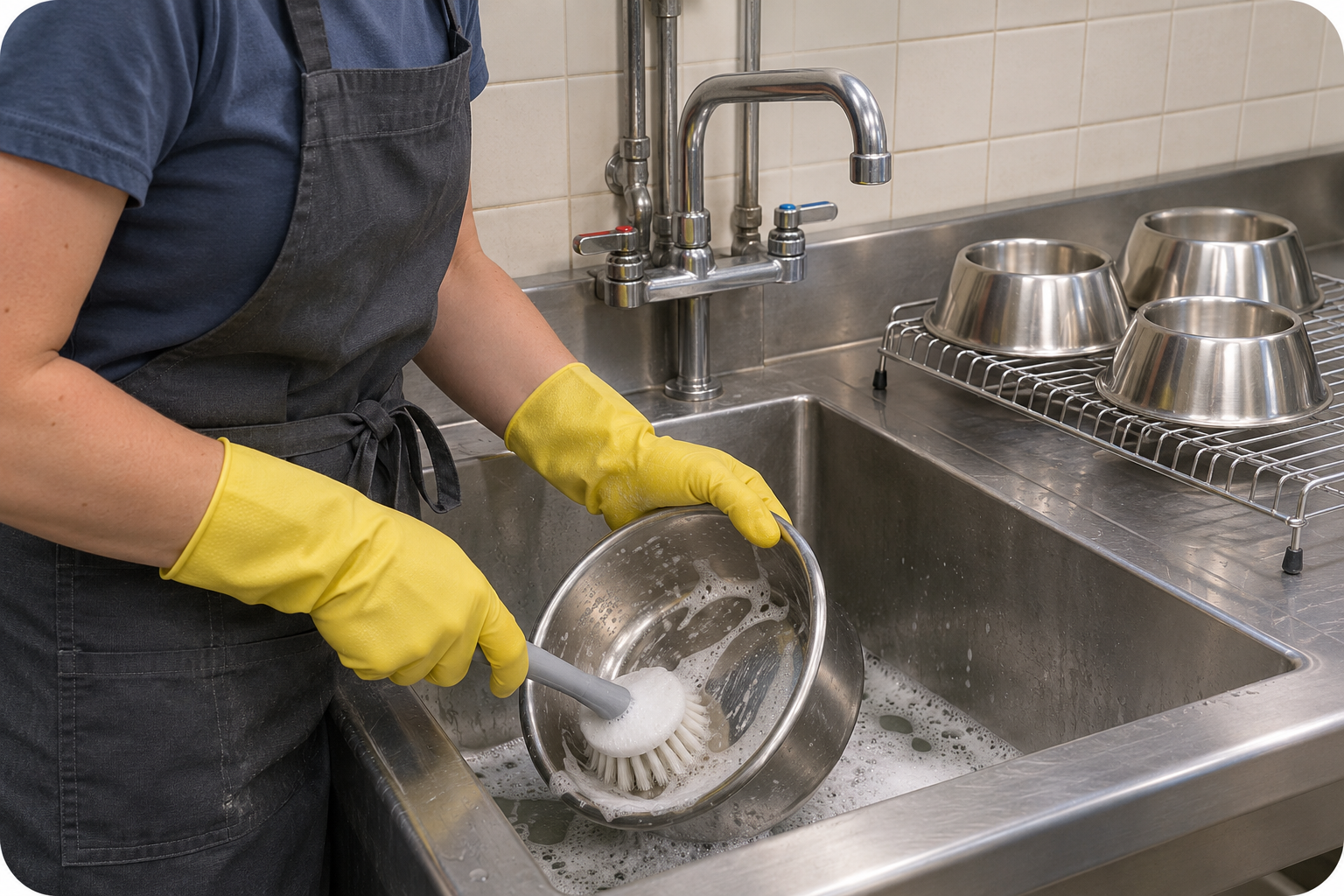
- Bowls: scrub with dish soap, rinse, then disinfect.
- Toys: hard toys soak in disinfectant or run through a dishwasher sanitize cycle. Fabric toys go in the washing machine with the bedding. A facility with about 80 daycare dogs a day washes and disinfects toys every day.
- Small weekly jobs: one facility changes its HVAC filter every Friday and doesn't allow items from home, which cuts down on laundry and lost belongings.
- No drains? Owners without floor drains use a mop-and-vacuum floor scrubber, squeegees and fans, or a steamer after disinfecting.
Who does the cleaning
Cleaning burns staff out when it piles onto whoever is free.
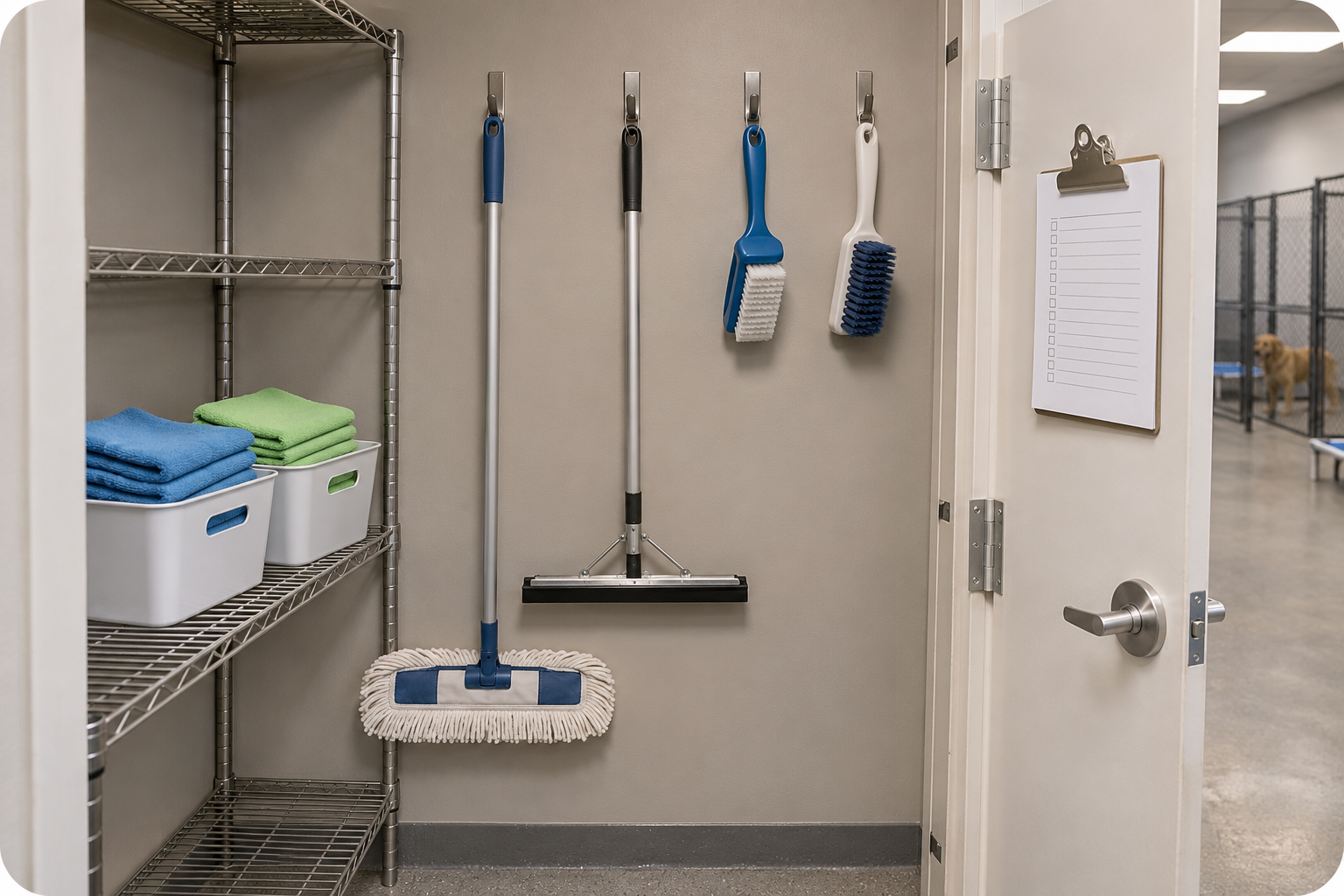
Owners who keep it under control assign each shift a specific main cleaning duty, keep the same schedule every week, and split the work evenly. Some match tasks to people: staff who like cleaning kennels get the kennel shift. Others post the mixing instructions and the cleaning checklist right on the supply closet door.
Dirty dogs coming in
Cleaning isn't only about the building.
Several owners have written cleanliness policies for dogs that arrive excessively dirty, matted, or greasy. Approaches range from offering a bath at intake, to a free exit bath on longer stays, to a stated cleaning fee. Put whichever you choose in writing before you need it.
Parvo and outbreak cleaning
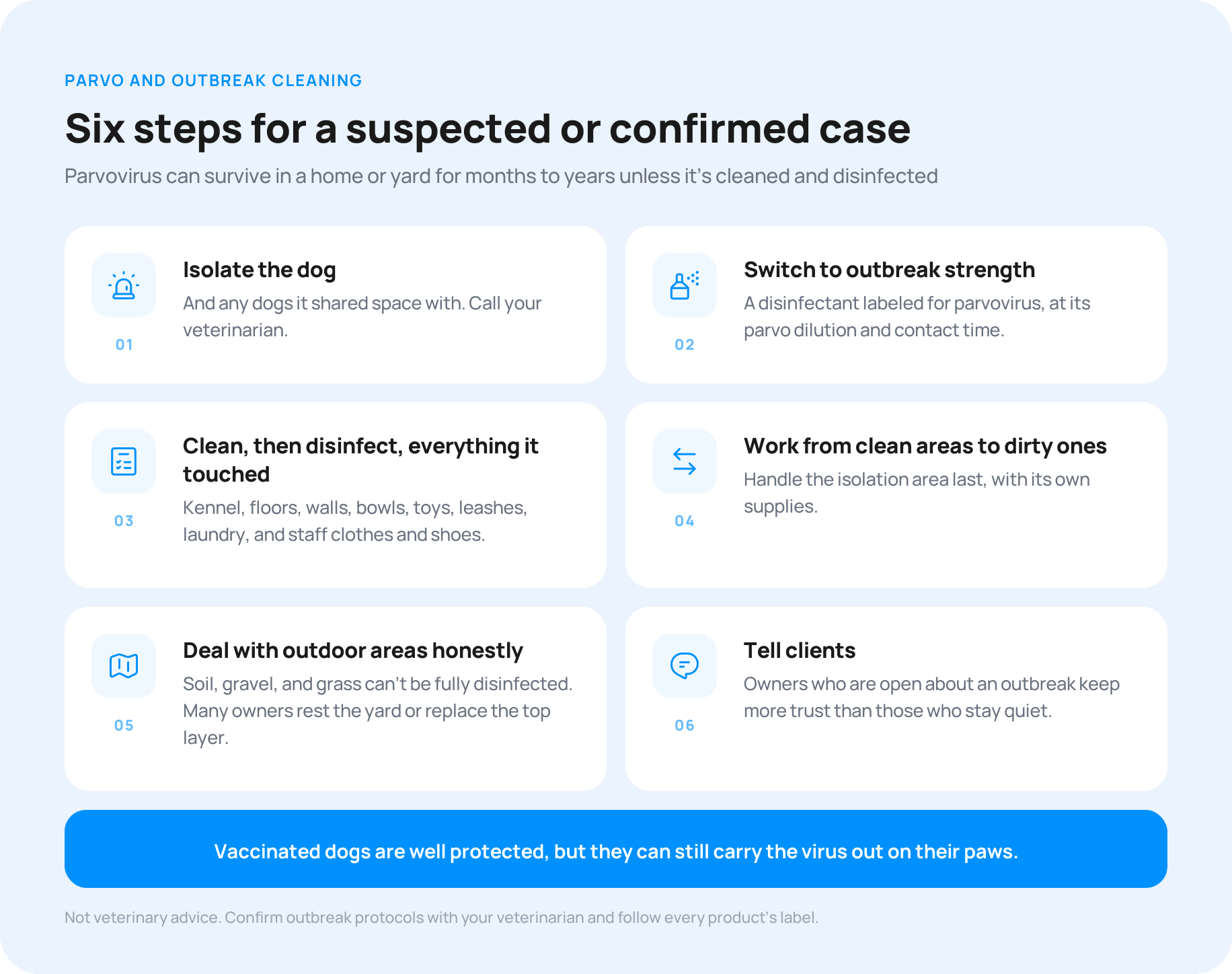
Parvovirus is the reason the details above matter. It can survive in a home or yard for months to years unless it's removed with cleaning and disinfection (Mass.gov). Vaccinated dogs are well protected, but they can still carry the virus out on their paws.
If you have a suspected or confirmed case:
- Isolate the dog and any dogs it shared space with. Call your veterinarian.
- Switch to outbreak strength. Use a disinfectant labeled for parvovirus at its parvo dilution and contact time.
- Clean, then disinfect, everything the dog touched: kennel, floors, walls, bowls, toys, leashes, laundry, and the clothes and shoes of staff who handled it.
- Work from clean areas to dirty ones, and handle the isolation area last, with its own supplies.
- Deal with outdoor areas honestly. Hard surfaces can be cleaned and disinfected. Soil, gravel, and grass can't be fully disinfected, so many owners stop using an affected yard for susceptible dogs or replace the top layer. Ask your vet what's realistic for your space.
- Tell clients. Owners who are open about an outbreak keep more trust than those who stay quiet.
What the rules require
Few US states spell out cleaning steps for daycares, but those that regulate kennels set a clear baseline. Check your state and local rules.
|
Jurisdiction |
Cleaning requirement |
Source |
|
Connecticut (commercial kennels) |
Disinfecting means killing pathogens, including canine parvovirus, with an approved chemical or water of at least 180°F on a clean surface; waste removed from runs and exercise areas at least once a day |
|
|
Iowa (dog daycares) |
All areas dogs can reach must be cleaned and sanitized at least once every 24 hours |
|
|
England (licensed dog daycare) |
Feces removed at least twice a day; dogs moved out while an area is cleaned; disinfectants must kill viruses as well as bacteria and be used per the manufacturer; toys cleaned and disinfected after play; no standing water |
This guide isn't veterinary advice. Confirm outbreak protocols with your veterinarian and follow every product's label.
The daily cleaning protocol, step by step
Use this for each kennel, suite, or play area. Post it next to your cleaning supplies.
- Move dogs out. Never spray disinfectant with dogs in the space.
- Remove all waste and debris. Pick up feces, soak up urine, and remove hair, food, and bedding.
- Scrub with a detergent. Dish soap or a degreaser breaks up the film that disinfectant can't get through. Rinse.
- Apply disinfectant at the right strength. Use routine strength for daily work and parvo strength when there's illness in the building.
- Leave it wet for the full contact time. If it dries early, it hasn't finished working. Many products need around 10 minutes.
- Rinse if the label says to, then dry. Standing water breeds germs and makes floors slippery. Use a squeegee, scrubber, or fans if you don't have drains.
- Wash bowls, toys, and bedding on their own schedule, separately from floors.
- Log it. Record who cleaned what, and when.
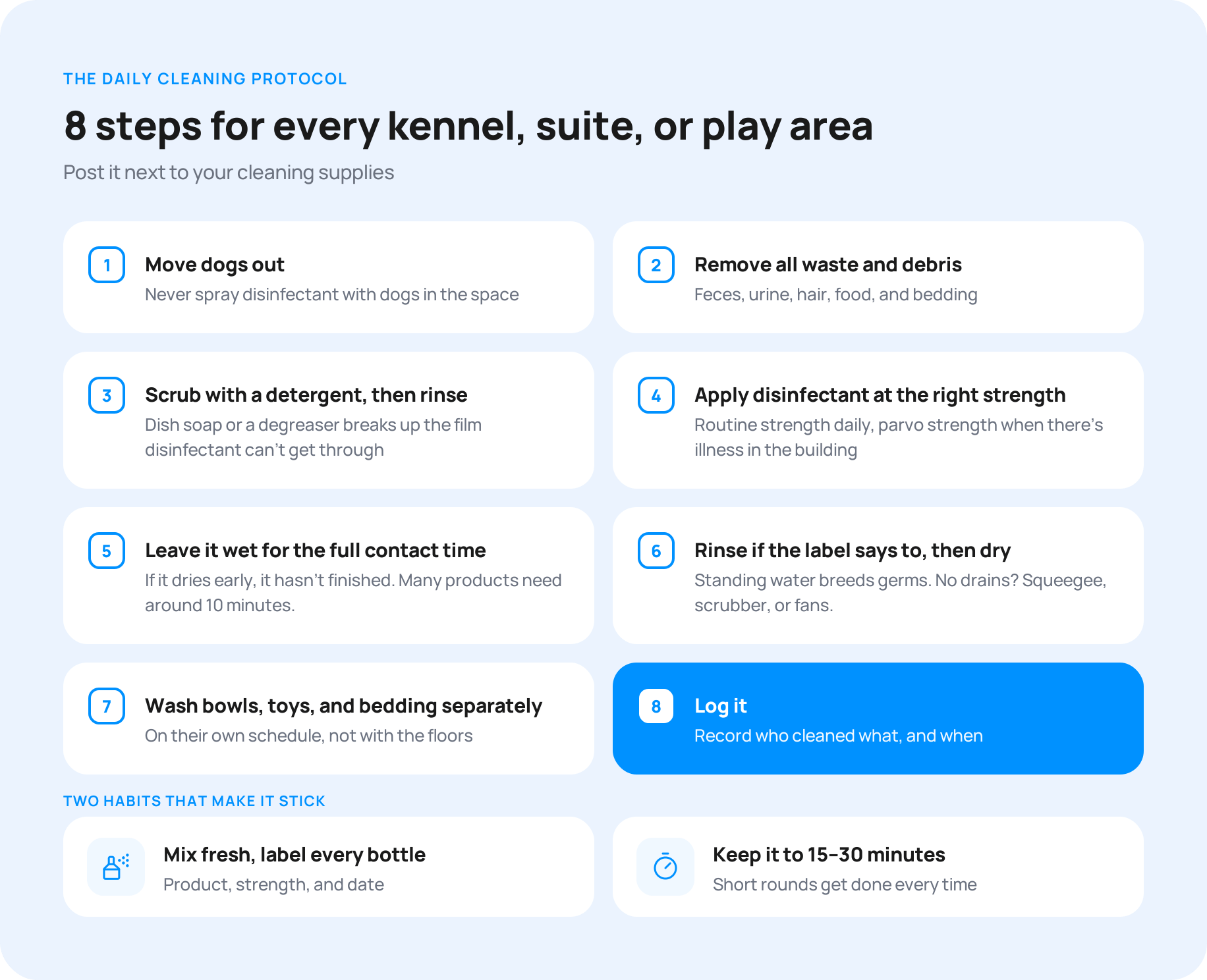
Two habits make this stick. First, mix disinfectant fresh and label every spray bottle with the product, strength, and date. Second, keep the routine short and fixed. Owners whose rounds take 15 to 30 minutes get them done every time. Owners who rely on occasional deep cleans fall behind.
If your building still smells after all this, the problem is usually the floor, not the cleaning. Porous surfaces absorb urine, and no product fully fixes that. See our guide to dog daycare flooring.
Best Flooring for Dog Daycare and Boarding Facilities: The 2027 Guide
Concrete, epoxy, rubber, vinyl, or turf? MoeGo daycare and boarding owners share what held up, what stank, and what they ripped out. Plus a 2027 buyer's guide.
Make the routine impossible to skip
A protocol only works if every shift follows it.
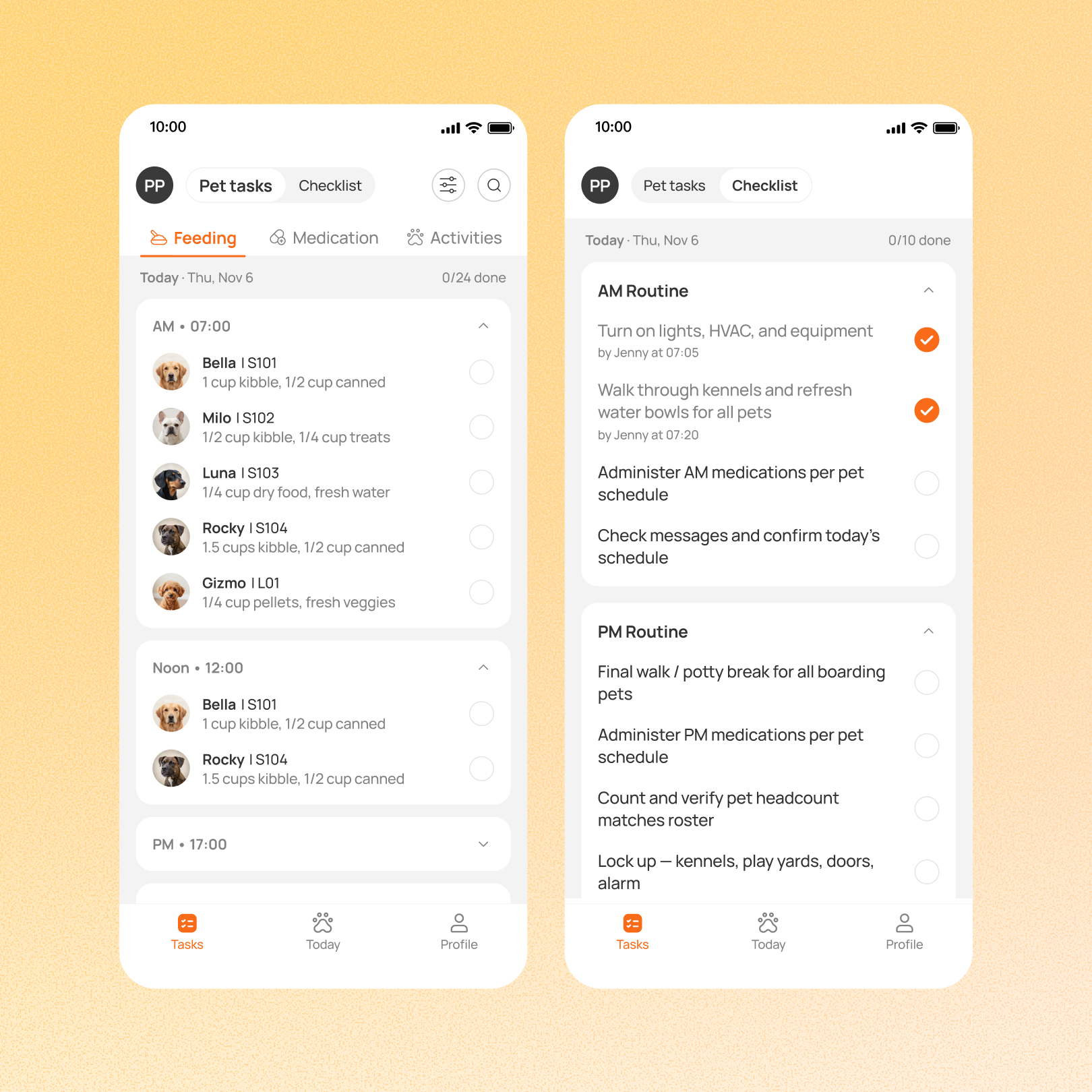
With the MoeGo Team App, staff can check off opening, closing, and cleaning checklists from their phones, and each completion is recorded with their name and the time (see how it works). Managers can see what's done without walking the building, and you have a cleaning log ready if an inspector or a worried client asks.
Frequently asked questions
What is the best disinfectant for a dog daycare or boarding kennel?
Accelerated hydrogen peroxide is the most common choice among experienced owners and is favored in shelter-medicine guidance. It kills parvovirus at its labeled parvo strength, has some cleaning action of its own, and is gentler than bleach. Whatever you choose, check that the label lists canine parvovirus.
Does quaternary ammonium (quat) disinfectant kill parvo?
Not reliably. Veterinary sources describe quats as not reliably effective against non-enveloped viruses like parvovirus. Many facilities use quats for everyday cleaning but switch to a parvo-rated product for disinfection and outbreaks.
Is bleach safe to use in a dog kennel?
Bleach kills parvo on a clean surface, but it stops working when any waste is present, corrodes metal, and can irritate dogs' and staff's airways. Many owners avoid it around dogs. Never mix bleach with ammonia or other cleaners.
How often should a dog daycare be cleaned?
Remove waste as soon as you see it and run a full cleaning round at least once a day. Many facilities clean twice a day. Some regulations set minimums, such as daily sanitizing in Iowa and feces removal at least twice a day in England.
How do you disinfect a kennel after parvo?
Isolate the sick dog, remove all waste, scrub with detergent, then apply a parvo-rated disinfectant at its parvo strength and leave it wet for the full contact time. Clean everything the dog touched, including laundry and staff clothing. Confirm the protocol with your veterinarian.
How do I get rid of urine smell in my dog daycare?
Remove urine quickly and use an enzyme cleaner on soft or porous surfaces. If smell lingers after consistent cleaning, the floor is usually absorbing urine, and sealing or replacing it is the real fix.
Just starting or adding to your business?
We have flexible plans meant for all stages.

How to Clean a Dog Daycare or Boarding Facility: The 2027 Guide
Vaccine Requirements for Dog Daycare and Boarding: The 2027 Guide