Share this
by MoeGo on Feb 23, 2026, 9:00:03 AM
Curious how much dog daycare owners actually make in 2027?
The short answer: it depends far more on operational efficiency and margin control than on the number of dogs in the building.
Below, we break down:
- Average owner salary ranges
- Real revenue examples by business size
- Typical profit margins
- Startup costs and break-even timelines
- What separates $60k owners from $300k+ operators
This is a practical guide for serious pet care entrepreneurs.

Quick Answer: What Is the Average Dog Daycare Owner Salary?
In 2026, dog daycare owner income typically falls within these ranges:
- Home-based daycare (5–10 dogs): $25,000–$60,000/year
- Single commercial location: $60,000–$150,000/year
- High-performing or multi-location operators: $150,000–$500,000+
However, revenue alone does not determine salary.
Owner income depends on:
- Utilization rate
- Pricing strategy
- Labor efficiency
- Client retention
- Revenue mix (boarding, grooming, retail add-ons)
Two facilities with identical capacity can produce drastically different take-home pay.
What Determines a Dog Daycare Owner’s Income?
Most new owners focus on capacity. Experienced operators focus on utilization and margin.
Here are the real drivers of owner salary.
1. Capacity Utilization (Not Just Size)
A 40-dog facility running at 60% capacity is far less profitable than a 25-dog facility running at 90%.
Simple formula: Daily Revenue = Dogs × Average Price × Utilization Rate
Example:
- 30 dogs × $35/day × 60% utilization = $630/day
- 30 dogs × $35/day × 85% utilization = $892/day
- That’s a 41% revenue difference without expanding space.
High-performing operators track utilization weekly, not annually.
2. Revenue Mix: Daycare vs Boarding vs Add-Ons
Not all services carry equal margins.
Revenue Mix Snapshot
- Daycare: Volume-based, moderate margin
- Boarding: Higher margin, seasonal peaks
- Grooming/Training Add-ons: Strong margin enhancers
- Retail: Supplemental but scalable
Owners who layer services increase revenue per client without increasing rent.
3. Labor Efficiency
Labor is usually the largest expense: often 35%–50% of revenue.
Common margin leaks:
- Overstaffed slow days
- Underutilized groomers
- Manual scheduling inefficiencies
- Excess overtime
Healthy operations align staffing with booking density and monitor productivity per employee. Without visibility, margin quietly erodes.
Real Revenue & Profit Scenarios by Business Size
Let’s examine three real-world examples.
Small Home-Based Dog Daycare (5 Dogs at a Time)
The business runs like this:
- Charge: $25/day
- 5 dogs × 20 weekdays/month
- Monthly revenue: $2,500
- Annual revenue: $30,000
Expenses are lower (home-based), so margins can be strong.
Estimated take-home: $20,000–$40,000 depending on overhead and add-ons.
This model works best as:
- Supplemental income
- Lifestyle business
- Low-risk entry into pet care
Medium Commercial Facility (20 Dogs Capacity)
The business runs like this:
- $30 daycare
- $45 overnight boarding
- 75% utilization
- 10 boarding dogs daily
- 10 daycare dogs weekdays
Estimated annual revenue: ~$230,000–$260,000
Typical cost structure:
- Labor: 40%
- Rent & utilities: 20–25%
- Insurance, software, supplies: 10–15%
Estimated profit margin: 10%–20%
Owner take-home: ~$40,000–$80,000
At this stage, operations determine income more than demand.
Large Facility (50 Dogs Capacity)
The business runs like this::
- $40 daycare
- $55 boarding
- 75% utilization
Estimated annual revenue: ~$1.1M
Healthy multi-service operations may see:
- 15%–25% EBITDA (Earnings Before Interest, Taxes, Depreciation, and Amortization) margins
Owner take-home: $150,000–$300,000+ depending on structure.
The difference? Systems. Large facilities without operational discipline often underperform smaller, tighter operations.
How Much Does It Cost to Open a Dog Daycare?
Startup costs vary dramatically.
Typical Investment Ranges:
- Home-based daycare: $5,000–$20,000
- Small commercial facility: $50,000–$150,000
- Large or premium facility: $150,000–$350,000+
Major costs include:
- Leasehold improvements
- Flooring & drainage
- Kennels & gates
- Licensing & insurance
- Initial marketing
- Working capital buffer
How Long Until a Dog Daycare Becomes Profitable?
Most facilities reach consistent profitability within: 12–24 months
Faster if:
- Pre-booked before opening
- Membership or package model used
- Strong rebooking systems in place
- Labor tightly managed
Slower if:
- Underpriced services
- High rent relative to revenue
- Weak client retention
Break-even occurs when: Fixed Costs + Variable Costs = Revenue
Owners should model this before signing a lease.
Are Dog Daycares Profitable?
Yes, but only when run with operational discipline.
Typical EBITDA margins:
- Struggling operations: 5%–10%
- Healthy single location: 15%–25%
- Multi-location with strong systems: 20%–30%
Dog daycare is not a high-margin industry by default. Profitability is operational.
Why Some Owners Stay at $60k, and Others Scale to $300k+
Revenue growth does not automatically equal income growth. Here are the most common income ceilings:
- No-Show Leakage: Manual reminder calls lead to 10–25% revenue loss.
- Weak Rebooking Systems: Clients visit once, then disappear.
- No Visibility Into Daily Performance: Owners rely on manager updates instead of real-time numbers.
- Inconsistent Pricing Enforcement: Manual discounts erode margin.
- Admin Overload: Hours spent on spreadsheets instead of growth.
The difference between a plateau and a scale is usually infrastructure.
How to Increase Your Dog Daycare Owner Salary
Without adding chaos. This is where systems matter.
If you're running on spreadsheets or fragmented tools, growth creates stress instead of income.
Automated Reminders & Rebooking
How It Works
Clients receive automatic SMS/email reminders and prompted rebooking flows after each visit.
Operational Impact
Fewer no-shows. Higher repeat visit rate. No manual chasing.
Business Outcome
Revenue predictability and margin protection.

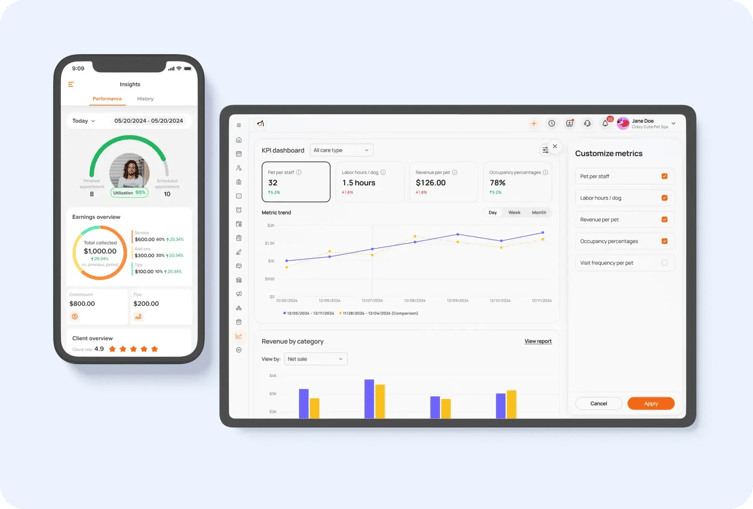
Real-Time Performance Dashboard
How It Works
Daily visibility into bookings, revenue, utilization, and staff productivity.
Operational Impact
Immediate detection of underperformance. Data-driven staffing decisions.
Business Outcome
Higher labor efficiency and increased owner take-home.
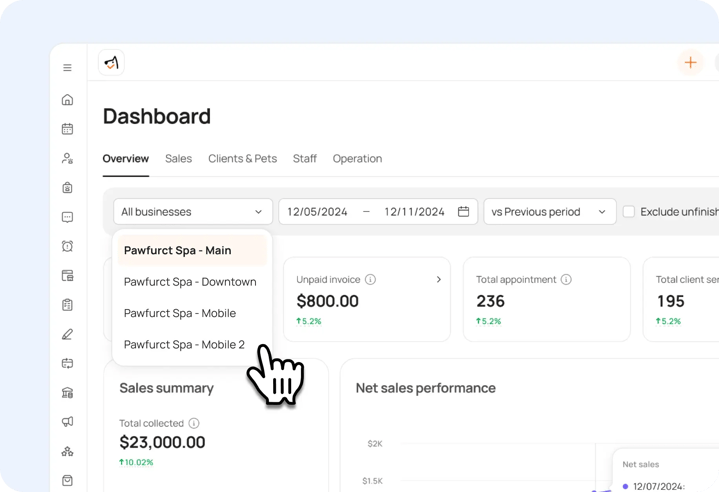
Centralized Multi-Location Reporting
For scaling operators.
How It Works
All locations feed into one unified system with cross-location visibility.
Operational Impact
Standardized booking rules and pricing enforcement.
Business Outcome
Scalable growth without losing control.
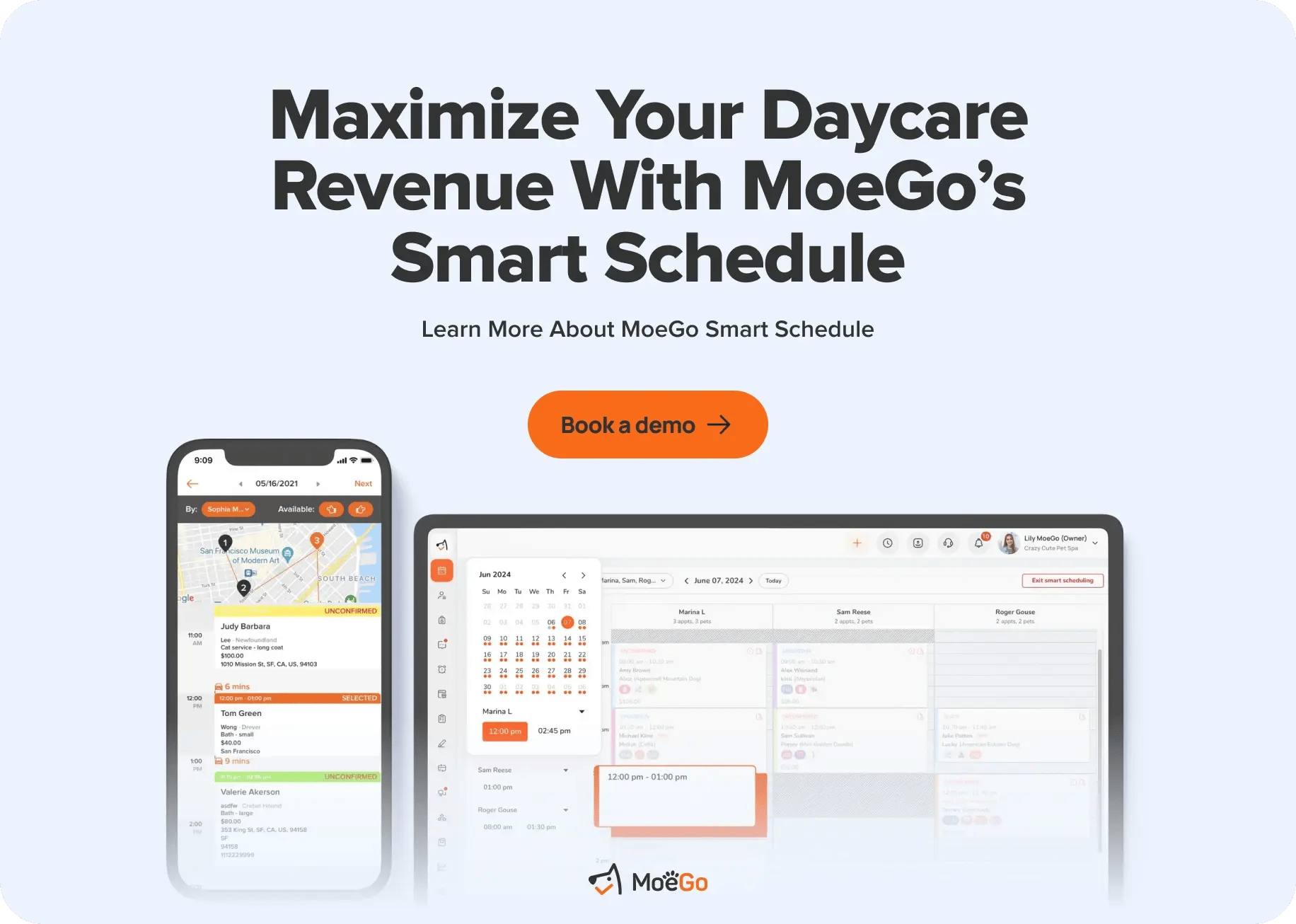
Modern operators rely on integrated pet care management software to centralize scheduling, payments, reporting, and client communication in one system.
If you run daycare specifically, purpose-built dog daycare software allows you to track utilization, automate reminders, and protect margin as you grow.
If you're still in planning mode, start with our guide on how to start a dog daycare to model costs and break-even properly.
Is Dog Daycare Ownership Worth It?
Financially, it can be. Strategically, it can become a durable asset.
Well-run facilities offer:
- Recurring revenue
- Predictable cash flow
- Multi-location scalability
- Exit valuation potential (often 2–5× EBITDA depending on structure)
But without systems, growth creates burnout instead of wealth. Dog daycare ownership rewards operators who treat it as both:
- A service business
- And a performance-driven operation
The owners who build visibility, standardization, and retention into their foundation are the ones who see their salary compound over time.
If you're serious about increasing profitability, not just revenue, the right operational infrastructure makes the difference between running a daycare and building a scalable business.
Just starting or adding to your business?
We have flexible plans meant for all stages.


From Pet Professional to CEO: How One Business Owner Took a 2-Week Vacation Without Her Business Falling Apart

Holiday Grooming Add-Ons: How to Build a Seasonal Menu That Sells Itself

How KLŌS Fine Pet Salon Turned Milton, Georgia's Most Discerning Zip Code Into Its Biggest Advantage